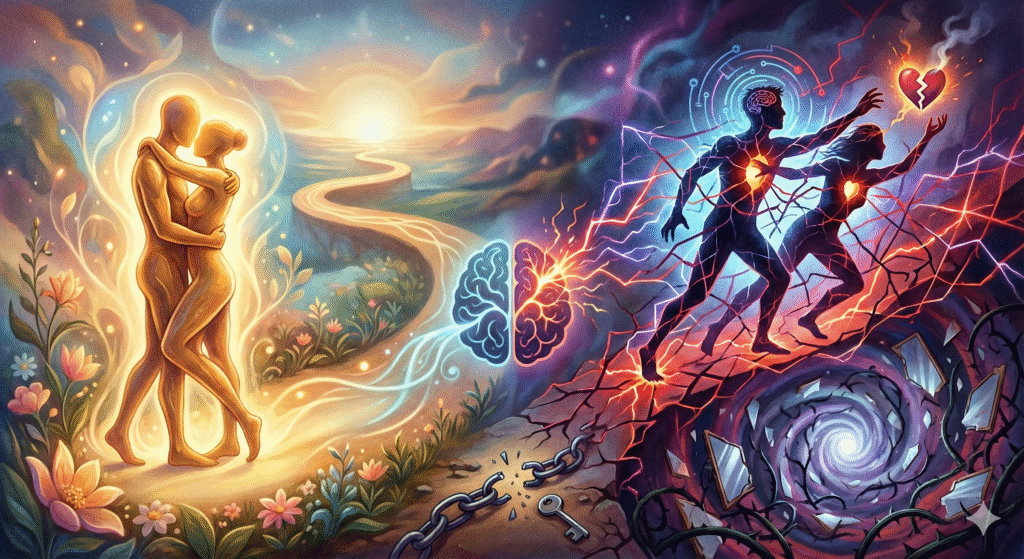
Love is often described as the most profound of human experiences—a force that drives art, survival, and the very fabric of our families. But what happens when that force mutates? What happens when the biological drive for connection spirals into a compulsion that dismantles lives, mirrors the devastation of substance abuse, and leaves individuals trapped in a cycle of euphoria and despair?
At Tripta Foundation, our mission is championing individual wellness and setting new standards in quality care. We believe in moving from distress to “Tripta”—the Sanskrit state of bliss, satisfaction, and contentment. To do that, we must sometimes shine a light on the misunderstood corners of mental health. A recent and illuminating piece in The Guardian, “Love addiction explained” (Matei, 2025), has reopened the conversation on a controversial but deeply felt condition: love addiction. Drawing from that article and a breadth of scholarly research, this post explores the intricate, often painful realities of love and sex addiction, offering a roadmap from obsession to authentic connection.
The Paradox of Passion
Most of us know the “rush” of a new romance. It is a state of altered consciousness, characterized by intrusive thoughts, boundless energy, and a feeling that life has suddenly snapped into technicolor focus. This is nature’s design. As noted in The Guardian, being in love is “phenomenologically identical to being high” (Matei, 2025). It is a pleasurable, thrilling, and somewhat scary state that compels us to bond.
However, for a segment of the population—estimated at roughly 3% in a 2011 study by University of Southern California psychologist Dr. Steve Sussman—this natural process derails (Matei, 2025). The behavior becomes uncontrollable. The “high” becomes the only thing that matters, and the pursuit of it begins to erode the person’s ability to live a balanced life. This is where love addiction begins.
Defining the Undefinable: What is Love Addiction?
Love addiction is not currently a formal diagnosis in the DSM-5 (Diagnostic and Statistical Manual of Mental Disorders), a fact that complicates treatment and validation for those who suffer from it. However, as The Guardian highlights, many researchers and clinicians use the term as a shorthand for “maladaptive romances” or a form of behavioral dependence (Matei, 2025).
A 2023 research survey framed love addiction within the category of behavioral addictions, sharing real estate with gambling, gaming, and shopping disorders. The authors of that survey describe it as “an incessant need” for romantic relationships, driven by “dysfunctional behaviors associated with a recurrent fear of abandonment” (Matei, 2025).
The symptoms often mirror those of substance dependence. Researchers have identified key markers in love addiction that align with the addiction model:
- Salience: The romantic interest dominates all thoughts, feelings, and behaviors.
- Mood Modification: The partner (or the chase) is used as a coping mechanism to numb negative feelings or escape reality.
- Tolerance: The need for more “intensity” or time with the partner to achieve the same emotional effect.
- Withdrawal: Physical and emotional distress when separated from the partner or when the relationship ends.
- Conflict: The obsession interferes with work, social life, and other responsibilities.
Dr. Steve Sussman’s research (2010) further characterizes this state as “immature love.” Unlike healthy attachment, which grows more secure and calm over time, love addiction is marked by desperation. The addict may feel hollow and nonexistent when single, or they may “replace ended relationships immediately” to avoid the crushing weight of withdrawal (Sussman, 2010).
The “Lava” of Addiction
One of the most poignant modern explorations of this theme comes from Elizabeth Gilbert, author of Eat, Pray, Love. In her memoir All the Way to the River (2025), Gilbert details her own descent into what she terms “love and sex addiction” following the terminal diagnosis of her partner, Rayya Elias.
Gilbert introduces the concept of “Lava”—an acronym used in recovery circles standing for Love, Acceptance, Validation, and Approval (Matei, 2025). For the love addict, Lava is the drug of choice. It is not just about wanting to be with someone; it is about consuming them to fill an internal void. Gilbert writes, “What we commonly call an ‘addict,’ I believe, is just an exaggerated version of all of us—just a person so desperately in search of relief from the sting of life that they will use anything (or anyone) to soothe it” (Gilbert, 2025).
This distinction is vital. While healthy love is about mutuality and growth, love addiction is often about consumption and enmeshment. Shena Lashey, a counselor specializing in this field, notes that “not all codependents are love addicts, but all love addicts are codependent” (Matei, 2025). The relationship becomes a way to outsource self-esteem, safety, and identity to another person, inevitably leading to a loss of self.
The Neurobiology of Longing
To understand why someone would sacrifice their dignity, career, or well-being for a relationship that is clearly harmful, we must look at the brain. The behaviors associated with love and sex addiction are not merely “bad choices”; they are driven by powerful neurobiological currents.
The “spark” of romance triggers the release of dopamine in the brain’s reward system, specifically in the Ventral Tegmental Area (VTA) and the Nucleus Accumbens. This is the same neural pathway hijacked by cocaine and nicotine (Fisher et al., 2016). When a person falls in love, they are essentially bathing their brain in a natural stimulant that promotes focus, energy, and craving.
In a healthy trajectory, this dopaminergic fire eventually settles into a warm glow, regulated by oxytocin and vasopressin—the neuropeptides of long-term attachment and bonding. This transition allows couples to move from the anxiety of “does he/she like me?” to the security of “we are partners.”
For the love or sex addict, this transition often fails. They may be addicted to the dopamine spike of the chase or the fantasy, rather than the reality of the person. This is why many “relationship addicts” bounce from one new partner to another; they are chasing the chemical high of the “honeymoon phase” (Sussman, 2010).
Furthermore, the stress hormone cortisol spikes during early love, creating a state of alert anxiety. For someone with a history of trauma or insecure attachment, this anxiety can feel like “passion.” They may mistake the nervous system dysregulation of an unstable relationship for “true love,” because calm relationships feel boring or “dead” to a brain rewired for chaos.
Distinguishing Sex Addiction from Love Addiction
While The Guardian notes that love and sex addiction often overlap—Gilbert herself identifies as both—it is crucial to understand the distinctions, especially given the evolving landscape of psychiatric diagnosis.
Sex Addiction (often termed hypersexuality) is characterized by compulsive engagement in sexual behaviors—pornography, masturbation, casual sex, or paid sexual services—despite negative consequences. The focus here is often on the act or the release rather than the relational bond.
It is important to note that the World Health Organization’s ICD-11 (International Classification of Diseases, 11th Revision) has introduced a diagnosis relevant to this: Compulsive Sexual Behavior Disorder (CSBD). It is defined as a “persistent pattern of failure to control intense, repetitive sexual impulses or urges resulting in repetitive sexual behaviour” (World Health Organization, 2019). Crucially, the ICD-11 categorizes this as an impulse control disorder, not strictly an “addiction” in the same category as substance use disorders, though the debate among scholars continues.
In contrast, Love Addiction is preoccupied with the person or the fantasy of the relationship. A love addict might be celibate but obsessed with an unavailable partner. Their “acting out” might not be sexual; it might be checking the partner’s social media 50 times an hour, driving past their house, or engaging in “protest behavior” to get a reaction.
However, the two frequently feed into each other. A person might use sex to get love (a common pattern for female love addicts, according to some clinicians), or use the “romance” of a new affair to justify compulsive sexual behavior. This cross-addiction creates a complex web that requires nuanced treatment.
The Role of Trauma and Attachment
Why does one person enjoy a summer fling and move on, while another spirals into a decade of obsession? The answer, almost invariably, lies in early development.
Shena Lashey traces compulsive emotional patterns back to childhood trauma, including abandonment, emotional neglect, or chaotic caregiving (Matei, 2025). This aligns with Attachment Theory.
- Anxious Attachment: These individuals crave intimacy but fear abandonment. They are hyper-vigilant to signs of rejection and may become “clingy” or demanding—classic traits of love addiction.
- Avoidant Attachment: These individuals equate intimacy with a loss of independence. They may become the “object” of a love addict’s obsession, creating a “push-pull” dynamic that is highly addictive to the anxious partner.
As Dr. Erin Davidson, a sex therapist, points out, the term “love addict” can sometimes be reductive. It is often more accurate to view these behaviors as a struggle with boundaries and enmeshment stemming from deep-seated unmet needs (Matei, 2025). The “addiction” is a survival strategy—a way to soothe a nervous system that was never taught how to self-regulate.
The Path to Rejuvenation: Treatment and Recovery
At Tripta Foundation, we believe in a whole-person approach to wellness. Recovery from love and sex addiction is not about “abstinence” in the way one abstains from alcohol. We cannot (and should not) abstain from love or sexuality. Instead, the goal is what the ICD-11 and recovery communities call “healthy relationality.”
1. Acknowledgment and Education The first step is breaking through the denial. Because society romanticizes “crazy love” (think of Romeo and Juliet or Wuthering Heights), many addicts believe their suffering is a badge of honor or proof of their deep capacity for feeling. Recognizing that these patterns are pathological—that they are “getting in the way of what a person wants for their life” (Matei, 2025)—is the turning point.
2. The 12-Step Model Organizations like Sex and Love Addicts Anonymous (SLAA) and Love Addicts Anonymous (LAA) provide a structured framework for recovery. As mentioned in The Guardian, these groups help members define “top line” behaviors (healthy goals, like seeking stable partnership) and “bottom line” behaviors (actions to avoid, such as stalking an ex on social media) (Matei, 2025). The community aspect is vital for breaking the isolation that secrecy breeds.
3. Therapy and Trauma Work Since these addictions are often rooted in trauma, trauma-informed therapy is essential. Cognitive Behavioral Therapy (CBT) can help identify distorted thinking patterns (“If I can just make him love me, I’ll be okay”). Deeper work, such as somatic experiencing or EMDR, can help heal the underlying attachment wounds.
4. Withdrawal and “Sober” Dating Elizabeth Gilbert describes the “lonely boredom of withdrawal” (Gilbert, 2025). When an addict stops the chaotic pursuit of high-drama relationships, life can initially feel flat. This “grey” period is actually the brain resetting its dopamine baseline. Learning to sit with oneself, to find “bliss, satisfaction, and contentment” (Tripta) from within rather than from an external source, is the core of the work.
For those in recovery, “sober dating” often involves a period of celibacy or dating abstinence to build a stronger relationship with the self. When dating resumes, it is done with rigorous honesty and clear boundaries.
Conclusion: From Addiction to Connection
The Roman poet Ovid, in his Remedia Amoris (The Remedy for Love), advised the love-struck to “withdraw your neck from the collar that hurts you” (Matei, 2025). Two thousand years later, the advice stands, but we now have the science to understand why the collar feels so tight and the compassion to help those trapped in it.
Love and sex addiction are not failures of character; they are dysregulations of our most fundamental drive for connection. By understanding the neurobiology, acknowledging the roots in trauma, and seeking community support, it is possible to break the cycle.
At Tripta Foundation, we champion the journey from the chaotic highs of addiction to the steady, nourishing warmth of true wellness. We believe that everyone deserves a love that is safe, a sexuality that is respectful, and a life that is truly their own.
References
- Fisher, H. E., Xu, X., Aron, A., & Brown, L. L. (2016). Intense, Passionate, Romantic Love: A Natural Addiction? How the Fields That Control Emotion and Motivation Interact. Frontiers in Psychology.
- Gilbert, E. (2025). All the Way to the River: Love, Loss, and Liberation. Riverhead Books.
- Matei, A. (2025, December 2). Is love addiction real – and what does it look like? The Guardian.
- Sussman, S. (2010). Love Addiction: Definition, Etiology, Treatment. Sexual Addiction & Compulsivity.
- World Health Organization. (2019). International Statistical Classification of Diseases and Related Health Problems (11th ed.).
Disclaimer
Important Notice: Not Medical or Psychological Advice
This blog post is intended for informational and educational purposes only. The content is based on general information, scholarly literature, and reports from sources such as The Guardian (Matei, 2025) and professional research. It is not a substitute for professional medical, psychological, or psychiatric evaluation, diagnosis, or treatment.
If you believe you are suffering from love addiction, sex addiction, Compulsive Sexual Behavior Disorder, or any other mental health condition, please seek personalized guidance from a qualified health professional (such as a licensed therapist, psychiatrist, or addiction counselor). Tripta Foundation encourages all readers to prioritize their safety and well-being by consulting experts for appropriate care.
Use of AI Tools
Please be advised that this content was generated with the assistance of an AI model. The AI was used for research aggregation, content synthesis, structuring, and drafting based on the user’s explicit request to incorporate a primary journalistic source (The Guardian) and supplemental scholarly materials. While efforts have been made to ensure factual accuracy and proper citation of the sources referenced, this output should not be considered a primary academic or clinical document. Any reliance on the information provided herein is solely at your own risk.