
The Uncomfortable Truth Nobody Wants to See
Walk into a typical modern family gathering, and you will likely see a familiar scene. The parents are vigilant, eyes darting toward their children, ready to confiscate an iPad or set a timer on a gaming console. We have become obsessed with monitoring our children’s screen time, regulating TikTok usage, and enforcing phone-free dinner tables—all in the name of protecting the developing brain from digital addiction. We read books on “digital parenting” and install blocker apps, convinced that the screen time crisis is a battle for the souls of the youth.
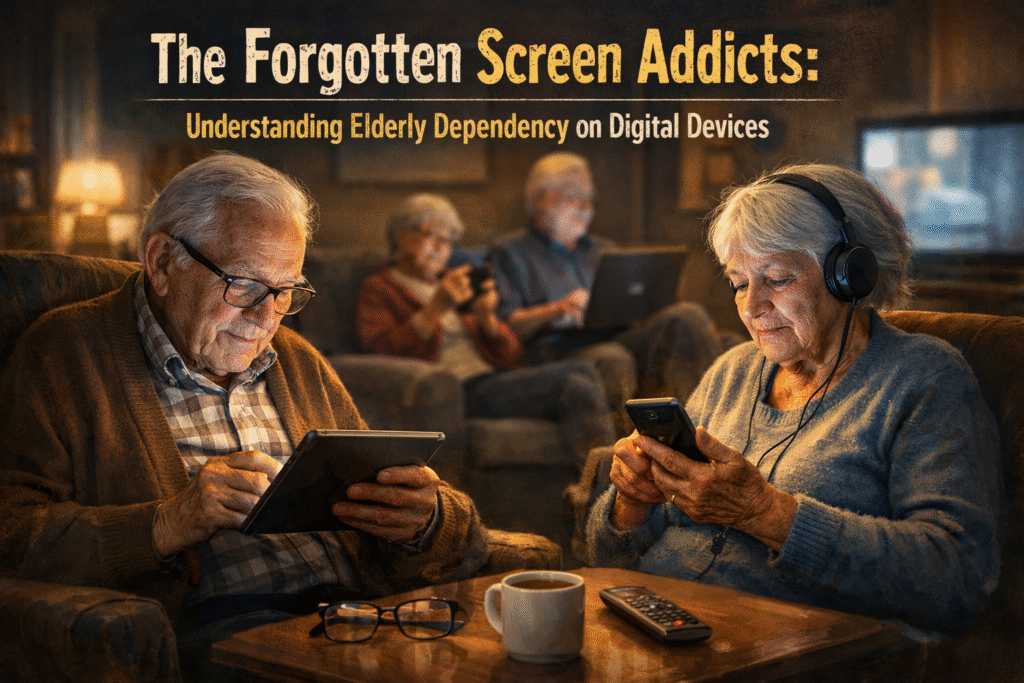
Yet, while we vigilantly police our kids’ devices, an equally troubling and far more silent phenomenon is unfolding in living rooms across the world. Look past the children, to the corner of the sofa, and you might see a grandparent, head bowed, face illuminated by the cool blue glow of a smartphone, scrolling with an intensity that rivals any teenager’s. They are watching endless loops of news clips, forwarding “health tips” on WhatsApp, or getting lost in the algorithmic labyrinth of Facebook Reels.
The irony is sharp and deeply uncomfortable. We shame children for phone addiction, treating it as a discipline issue, while completely overlooking the quiet dependence growing among our parents and grandparents. This is not merely a habit; it is a dependence that is far more complex, rooted not just in boredom, but in profound psychological pain and existential displacement.
Recent research reveals the magnitude of this overlooked crisis. In South Korea, a nation often considered a bellwether for digital trends, smartphone addiction risk among adults aged 60-69 reached 17.5% in 2021, a significant jump from previous years. This age group is now among the fastest-growing demographics for smartphone adoption globally. Similarly, studies from Turkey show smartphone penetration at over 90% in the 60-74 age group, shattering the outdated assumption that elderly populations remain digitally disconnected or “technologically illiterate.”
These statistics, however, barely surface in public discourse. The narrative remains stubbornly focused on Gen Z, while elderly screen dependency quietly reshapes the emotional landscape of aging. To understand this crisis, we must look beyond the device itself and examine what the screen is replacing. For a teenager, a phone might be a portal to social status; for the elderly, it is often a desperate bridge across a widening chasm of isolation.
The Retirement Void: When Work Ends and Meaning Disappears
To understand elderly screen addiction, we must first confront an uncomfortable reality about modern retirement. For decades, we are sold the dream of retirement as a “golden utopia”—a time of leisure, travel, and relaxation. But for millions, the reality is a jarring existential crisis.
Work provides more than a paycheck. In our society, it provides the primary scaffolding of the self. It offers identity (“I am a teacher,” “I am an engineer”), a daily structure (wake up, commute, perform tasks), a social network (colleagues, clients), and, perhaps most importantly, a sense of being needed. When retirement arrives, this scaffolding is dismantled overnight. The Tuesday morning meeting is gone; the deadline is gone; the sense that people are waiting for your input is gone.
Research on identity and retirement reveals this transition as fundamentally destabilizing. Identity Process Theory demonstrates that retirement forces individuals to incorporate new, often diminishing information about themselves into their personal identity. A retired manager loses their leadership identity; a retired nurse loses their caregiver identity. Without the structure that work provided, many elderly experience what researchers describe as a “psychosocial process of identity transition and search for meaning.”
This is not mere disappointment; it is existential disorientation. Studies document the psychological consequences: feelings of invisibility, difficulty answering the simple question “What do you do?”, and pervasive loneliness. This loneliness often emerges not from a lack of people, but from a lack of purpose. A retiree might have a loving family, but if they feel their daily existence contributes nothing to the world, they experience a profound internal void. Some describe feeling “useless” or “disillusioned,” as if they have been relegated to the status of an observer in a world they once helped build.
This is precisely where the smartphone steps in. It is the perfect antidote to the silence of the empty house. The phone offers constant stimulation, novelty, and, crucially, a form of pseudo-validation. Every notification, every chime, every vibration offers a tiny dopamine hit—evidence that something out there needs attention, that the user is still connected to the flow of information.
For a retiree struggling with the silence of a Tuesday afternoon, the phone is a lifeline. WhatsApp groups allow them to remain “in the loop,” transforming them into information brokers who share news and warnings with family members. YouTube offers the illusion of productivity—watching hours of political commentary or health advice feels like “research.” It transforms the passive act of aging into an active pursuit of knowledge. In this context, the phone is not a toy; it is an emotional crutch filling the massive crater that work once occupied.
The Science of Addiction: Why Elderly Brains Are Vulnerable
It is easy to dismiss elderly screen usage as a lack of discipline, but this view fundamentally misunderstands the neurobiology of aging. The mechanism of addiction—the dopamine loop—works identically on a 65-year-old brain as it does on a 15-year-old one, but the aging brain has specific vulnerabilities that make it harder to break free.
Smartphone apps are deliberately engineered to exploit the brain’s reward circuitry, specifically the nucleus accumbens. They employ a “variable ratio schedule of reinforcement”—the same psychological mechanic used in slot machines. When you pull to refresh a news feed, you don’t know what you’re going to get. It might be a boring update, or it might be an exciting piece of news or a photo of a grandchild. Research on pathological gamblers reveals that this uncertainty releases more dopamine than the reward itself. The anticipation is the hook.
For elderly individuals, this weaponized neurochemistry collides with age-related cognitive changes. As we age, our executive function—the brain’s CEO responsible for impulse control, delayed gratification, and decision-making—gradually declines. The prefrontal cortex, which acts as the “brake” on our impulses, naturally weakens. Simultaneously, the amygdala, the brain’s emotional processing center, often becomes more active or dominant in driving behavior.
This creates a “perfect storm” for digital dependency. An elderly user might make a conscious intention to “just check the weather,” but once the screen is on, the weakened prefrontal cortex struggles to inhibit the impulse to click the next video, and the next. They physically have less neural capacity to stop scrolling, despite wanting to.
Furthermore, research on “subjective cognitive decline” reveals a vicious cycle. When elderly individuals perceive that their memory or sharpness is fading, their confidence in their own self-control diminishes. They feel less capable of regulating their behaviors, leading to a sense of resignation: “I can’t help it.” The brain becomes trapped in a loop—attempting to regulate use, failing due to reduced executive capacity, and then using the phone as an emotional regulator to manage the shame and frustration of that failure.
The Content Trap: Emotion Over Accuracy
One of the most visible symptoms of elderly screen addiction is the susceptibility to misinformation, scams, and sensationalist content. We often attribute this to “cognitive decline,” assuming that older people just “don’t understand” the internet. However, research has thoroughly debunked the myth that age-related cognitive decline is the primary driver of fake news susceptibility. In fact, older adults often possess superior general knowledge and vocabulary compared to younger generations.
The true vulnerability lies in a mismatch between their “media operating system” and the modern digital landscape. Today’s elderly grew up in an era of institutional trust. If Walter Cronkite said it on the evening news, it was true. If a photo was printed in a newspaper, it was real. They evolved in a high-trust information environment.
They have now been air-dropped into a “post-truth” digital environment where attention is the only currency. They are navigating a landscape of clickbait, deepfakes, and algorithmic rage-bait with a map drawn in 1970. Research demonstrates that misinformation targets elderly users through emotional appeals rather than intellectual deception. A fake news story about a health scare or a political outrage triggers an immediate emotional response—fear, anger, or protective instinct. Because older adults often prioritize emotional regulation and social connection, they are more likely to share this content immediately to “warn” their loved ones.
This is why “WhatsApp University” thrives among seniors. Sharing a video about a dangerous new virus or a political conspiracy isn’t just about the facts; it’s an act of care. It says, “I am looking out for you.” When family members debunk these claims with cold facts (“Mom, that’s a deepfake”), it is often received not as a correction of facts, but as a rejection of care.
Critically, vulnerable elderly (those 70+) show particular susceptibility because they lack the specific digital literacy markers that younger natives have internalized. They cannot easily spot the “Sponsored” tag that denotes an ad, they don’t recognize the visual language of bot networks, and they don’t intuitively understand that the “Up Next” video was chosen by an algorithm designed to provoke them.
The Intergenerational Fracture: When Concern Becomes Judgment
Perhaps the most tragic aspect of this addiction is how it damages the very relationships the elderly crave. Research on parent-adult child relationships reveals that conflict now exceeds solidarity in many families, with technology often sitting at the center of the tension.
Adult children, watching their parents scroll endlessly, often respond with judgment and frustration. We treat them like teenagers: “Mom, put the phone away,” or “Dad, stop watching those angry videos.” But the dynamic is different. When we correct a child, we are teaching them. When we correct a parent, we are upending the hierarchy of respect.
Elderly parents experience this judgment as a profound dismissal. They feel their autonomy is being questioned and their presence rejected by the very children they raised. Research on intergenerational conflict highlights that elderly individuals often feel taken for granted, perceiving that the younger generation views them as obsolete liabilities rather than living human beings.
This judgment creates a feedback loop. As the elderly feel more judged and alienated by their physical families, they retreat further into their digital families. The phone becomes a shield—a safe space where they can engage with online communities that validate their fears and interests without rolling their eyes. In Facebook groups or YouTube comment sections, their views are affirmed. In the living room, they are sighed at.
The modern nuclear family structure exacerbates this isolation. Unlike multi-generational households of the past, where the elderly were naturally integrated into the chaotic flow of daily life and childcare, contemporary living arrangements often isolate seniors in quiet homes or apartments. The smartphone bridges this geographical and emotional distance, but it is a poor substitute for physical presence.
The Paradox of Independence
We must be careful, however, not to pathologize all technology use. The smartphone is a paradox: it is both a trap and a tool of incredible liberation.
For many seniors, the smartphone is the primary engine of their independence. It allows them to order groceries when they can’t drive, manage their bank accounts without standing in line, book doctors’ appointments via telehealth, and video call grandchildren who live on other continents. For a generation terrified of losing their independence and becoming a “burden,” the smartphone offers a way to maintain control over their lives.
The distinction lies in intention. Research shows that “instrumental” use—using the phone to accomplish a specific task or seek specific information—is protective. It enhances cognitive function and reduces loneliness. The danger lies in “ritualistic” or passive use—scrolling for entertainment, watching autoplay videos, or doom-scrolling news feeds.
An 75-year-old using an app to monitor their heart rate is empowered. An 75-year-old watching four hours of conspiracy theories is endangered. The challenge for families is to support the former while gently mitigating the latter, without stripping away the agency that the device provides.
The Way Forward: Rebuilding Purpose Beyond Screens
The data presents a clear imperative: addressing elderly screen addiction requires a fundamentally different approach than the one we use for children. We cannot simply use “parental controls” or confiscate devices. We must address the root cause: the vacuum of purpose.
As long as retirement represents a void—a loss of identity, community, and structure—screens will continue to fill that space. You cannot take away the crutch without healing the leg.
Research on successful aging demonstrates that elderly individuals who maintain a strong sense of purpose show dramatically lower rates of problematic technology use. The solution lies in creating conditions where the phone becomes optional, not essential for emotional survival.
This requires a shift in how we view retirement. It shouldn’t be the “end” of engagement, but a transition to new forms of it. Communities need to create roles for seniors that go beyond passive bingo nights—roles that utilize their skills, wisdom, and need to be needed.
For individual families, the conversation must shift from judgment (“You’re on your phone too much”) to curiosity (“What are you watching? What is interesting to you about that?”). We need to help our aging parents curate their digital environments, teaching them how to mute toxic channels and find content that enriches rather than enrages.
But more importantly, we need to offer alternatives to the digital dopamine hit. We need to integrate them back into the fabric of family life, not just as observers, but as participants. If the real world becomes more engaging, welcoming, and purposeful than the digital one, the screen will naturally lose its grip.
Conclusion: From Shame to Compassion
We have constructed an elaborate mythology around “digital natives,” believing that screen addiction is a young person’s disease. But the evidence suggests a more universal truth: addiction emerges wherever deep psychological need meets predatory technological design.
In young people, screen addiction often manifests as a fear of missing out (FOMO) and social anxiety. In the elderly, it manifests as a salve for existential invisibility. It is a desperate attempt to remain tethered to a world that seems to be moving on without them.
The real screen addicts are not just our children. They are our parents and grandparents. Our response to their scrolling shouldn’t be the annoyance we feel toward a teenager, but a compassionate curiosity about the silence they are trying to fill. Behind the hours spent on WhatsApp and YouTube lies a profound human need for connection, relevance, and purpose. Recognizing that pain is the first step toward helping them look up from the screen and back into the world.
References
- Times Now. (2024). The real screen addicts are not children; they are the elderly.
- National Institute on Aging. (2023). Smartphone addiction risk demographics in South Korea.
- Turkish Statistical Institute. (2023). Information and Communication Technology Usage Survey.
- Breakwell, G. M. (1986). Coping with threatened identities. Methuen.
- Wang, M., et al. (2011). The retirement process: A psychological and emotional journey.
- Amabile, T., & Kramer, S. (2011). The Progress Principle: Using Small Wins to Ignite Joy, Engagement, and Creativity at Work.
- Osborne, J. W. (2012). Psychological effects of the transition to retirement. Canadian Journal of Counselling and Psychotherapy.
- Volkow, N. D., et al. (2016). Neurobiologic Advances from the Brain Disease Model of Addiction. New England Journal of Medicine.
- Sapolsky, R. M. (2017). Behave: The Biology of Humans at Our Best and Worst. Penguin Press.
- Gazzaley, A., & Rosen, L. D. (2016). The Distracted Mind: Ancient Brains in a High-Tech World. MIT Press.
- Smart, C. M., et al. (2014). Mindfulness Training for Older Adults with Subjective Cognitive Decline.
- Haug, S., et al. (2015). Smartphone use and smartphone addiction among young people in Switzerland. Journal of Behavioral Addictions.
- Brashier, N. M., & Schacter, D. L. (2020). Aging in an Era of Fake News. Current Directions in Psychological Science.
- Carstensen, L. L., et al. (2003). Socioemotional Selectivity Theory and the Regulation of Emotion in the Second Half of Life. Motivation and Emotion.
- Guess, A., et al. (2019). Less than you think: Prevalence and predictors of fake news dissemination on Facebook. Science Advances.
- Hargittai, E., et al. (2019). Differences in Digital Literacy and the Spread of Misinformation.
- Primack, B. A., et al. (2017). Social Media Use and Perceived Social Isolation Among Young Adults in the U.S.. American Journal of Preventive Medicine.
- Fingerman, K. L., et al. (2004). Tensions in the Parent-Child Relationship in Adulthood.
- Clarke, E. J., et al. (1999). Solidarity, Conflict, and Ambivalence in Intergenerational Relationships.
- Klinenberg, E. (2012). Going Solo: The Extraordinary Rise and Surprising Appeal of Living Alone. Penguin Books.
- Schulz, R., et al. (2016). Technologies for Healthy Aging.
- Chopik, W. J. (2016). The Benefits of Social Technology Use Among Older Adults Are Mediated by Reduced Loneliness. Cyberpsychology, Behavior, and Social Networking.
- Pinquart, M. (2002). Creating and maintaining purpose in old age.
Disclaimer: This article was researched with the assistance of Artificial Intelligence tools. While AI was used to synthesize research, the core insights and final editorial review were conducted to ensure accuracy and human nuance.