
Introduction
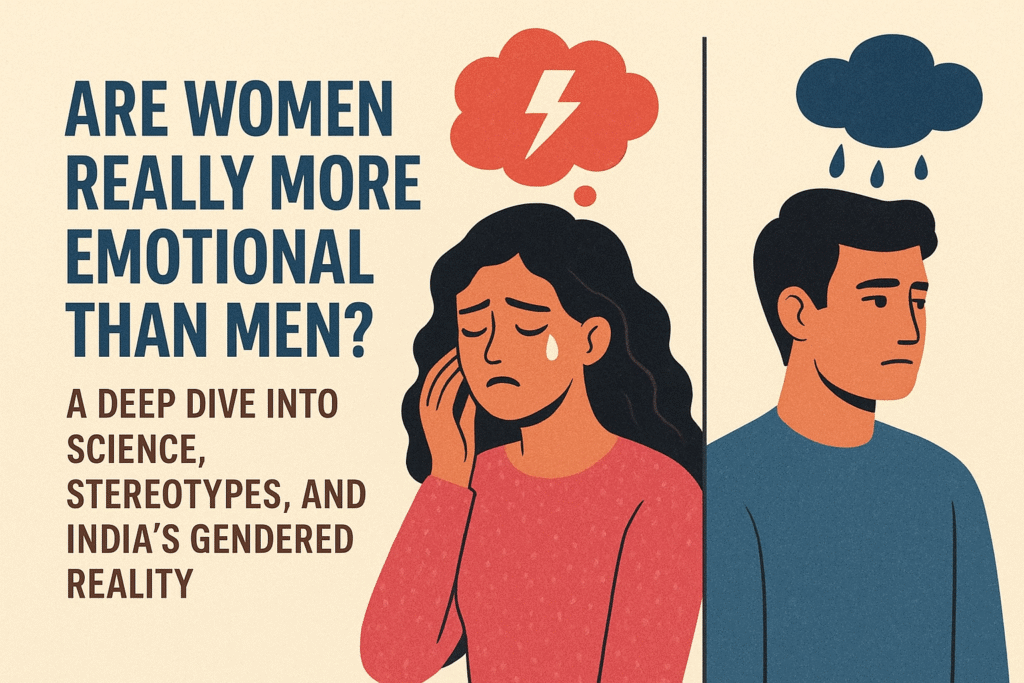
Across cultures and generations, the idea that “women are more emotional than men” has persisted as a powerful stereotype. Movies, workplace discussions, and even well-meaning family advice in India often reinforce the belief that men are rational and women are ruled by feelings. But does scientific evidence actually support this notion, or is it more product of socialization and cultural pressures? This blog unpacks new findings, debunks myths with scientific studies, and explores the implications for Indian society.
What Does Science Actually Say About Gender and Emotions?
Challenging the Core Myth
A landmark study highlighted by Verywell Mind shows that daily emotional fluctuations are remarkably similar between men and women, undermining stereotypes that women are innately more emotional (Verywell Mind, 2021). Comprehensive research tracking participants over 75 days found little to no differences in emotional highs and lows between men and women, regardless of hormonal cycles (University of Michigan, 2021). This evidence challenges long-standing justifications for excluding women from scientific research due to supposed uncontrollable “emotional variability”.
Gender Expression Is Not the Same as Emotional Intensity
Scientific reviews point out that while women may be more expressive of emotions outwardly, men experience emotions with equal intensity but often express them in different or less visible ways (Kret & De Gelder, 2012; McRae et al., 2008). For example, men are historically conditioned to externalize only certain emotions like anger or pride, while sadness, fear, and affection are suppressed due to cultural expectations (Gender.study, 2025; Kulsum & Sinha, 2023).
Neurobiological and Psychological Findings
Brain-imaging and psychological studies have found that although there are some subtle differences in emotional processing—such as more limbic system activation in women—the core neurological pathways for emotion in men and women are highly similar. Gender differences in emotional intelligence and regulation are more about strategy and style than about underlying capability or experience (McRae et al., 2008; Kaur et al., 2022; Hyde, Pethe, & Dhar, 2025).
The Indian Context: Culture, Socialization, and Emotional Stereotypes
Socialization from Childhood
In India, boys and girls are socialized differently from a young age. Boys are often reinforced for showing “strength” and are discouraged from displaying vulnerability or sadness, while girls are encouraged to be nurturing and emotionally open (Kulsum & Sinha, 2023; Kathuria, 2023). This means that Indian men may struggle to express their emotions or even recognize them, often leading to emotional bottling or unhealthy coping mechanisms (Kulsum & Sinha, 2023; Khosla, 2015).
Work, Family, and Emotional Labor
Recent research in Indian workplaces finds that women, especially those in middle and upper management, bear a higher burden of “emotional labor”—the expectation to absorb, manage, and display appropriate emotions for others (Taylor et al., 2021). However, the stress levels reported due to workplace demands are similarly high for both genders (Kerala State Youth Commission, 2025). The primary difference lies in the types of emotions expressed: Indian women are more likely to show empathy and cooperation, while men may default to assertiveness or disengagement (Koteswaramma, 2024).
A study by Kerala State Youth Commission on over 1,500 young Indian professionals found that 74.7% of women and 73.7% of men reported workplace stress in the past month, indicating nearly identical levels of felt stress (Kerala State Youth Commission, 2025).
Emotional Health and Gendered Mental Health Outcomes
Multiple Indian studies confirm that emotional suppression in men correlates significantly with increased depression, anxiety, and stress. However, men are less likely to seek help due to the stigma around expressing vulnerability (Kulsum & Sinha, 2023; Khosla, 2015). Women, on the other hand, may be more likely to express distress but also face social and workplace penalties for being seen as “overemotional”—especially in leadership roles (Gender.study, 2025; Sultana & Priyadarshini, 2018; Hyde, Pethe, & Dhar, 2025).
Certain studies also find that Indian adolescent girls exhibit poorer overall mental health than boys due to combined factors of gender discrimination, societal pressures, and lack of social support, though both genders experience substantial burdens from different sources (Yadav et al., 2023; Malhotra & Shah, 2015).
Indian Scientific Evidence: Key Studies
Emotional Expression and Mental Health in Indian Men
A large study among Indian men (ages 18-60) found a significant positive correlation between emotional expressivity and levels of stress, depression, and anxiety—the more difficulty men had expressing emotions, the greater their risk for mental health issues (Kulsum & Sinha, 2023). This suppression is rooted in societal expectations for stoicism and self-reliance, reinforcing a cycle of emotional bottling and mental health challenges (Kulsum & Sinha, 2023; World Journal of Advanced Research and Reviews, 2025).
Implications: educators, families, and workplaces must create spaces where men can safely express emotion without stigma (Kulsum & Sinha, 2023; Kathuria, 2023).
Gendered Emotional Intelligence and Regulation
Studies on Indian college students consistently show that females score higher on measures of emotional intelligence (EI), largely due to socialization—not biological differences (Hyde, Pethe, & Dhar, 2025). However, males demonstrate higher impulse control, while females have higher emotional clarity and are more adaptive in seeking social support (Kaur et al., 2022; Hyde, Pethe, & Dhar, 2025).
Workplace Emotional Expression and Gender
In professional environments, women are often penalized for emotional expressiveness, particularly if those emotions are negative (e.g., frustration or anger), while men may be lauded as assertive for the same displays (Gender.study, 2025; Taylor et al., 2021). Across industries, Indian men and women report high work stress, but women may face added burdens balancing cultural expectations about emotional labor and identity (Kerala State Youth Commission, 2025; Koteswaramma, 2024).
Why the Stereotype Persists: Cultural Roots and Social Reinforcement
- Bollywood and Mass Media: Indian films and television often reinforce tropes of the weeping mother, the angry young man, or the supportive wife, cementing expectations for how different genders should express emotion.
- Parenting and Education: Emotion socialization in India emphasizes respect for elders, emotional restraint in public, and gendered appropriate emotional responses (Kathuria, 2023).
- Workplace Norms: Traditional gender roles in the workplace perpetuate the myth that emotional expression is a weakness in men and an excess in women, creating barriers for authentic expression and supportive work environments (Taylor et al., 2021; Kerala State Youth Commission, 2025).
Breaking Myths, Moving Forward: What the Evidence Suggests
Key Insights
- Emotion is Human, Not Gendered: Men and women both feel, experience, and regulate emotions with similar intensity, but express them differently due to societal and cultural training (Verywell Mind, 2021; Kret & De Gelder, 2012; Kulsum & Sinha, 2023).
- Suppressing Emotion Hurts Everyone: Emotional repression, especially among men, is linked to higher risks for depression, anxiety, and unmet mental health needs (Kulsum & Sinha, 2023; World Journal of Advanced Research and Reviews, 2025).
- Expressive Double Standard: Women’s display of emotion is often stigmatized in leadership and professional settings, while men are praised for comparable expressions if deemed assertive (Sultana & Priyadarshini, 2018; Gender.study, 2025).
- Societal and Cultural Change Is Needed: Destigmatizing emotion for men, rewarding authentic emotional expression for all genders, and increasing mental health awareness are key steps forward for Indian society (Kulsum & Sinha, 2023; Kerala State Youth Commission, 2025; Koteswaramma, 2024).
What Can Families, Workplaces, and Society Do?
Action Points
- Challenge Stereotypes in Everyday Conversation: Avoid labeling emotional boys as “weak” and expressive women as “hysterical”—recognize individual emotional experiences as valid.
- Encourage Emotional Literacy: Schools and families should foster skills such as emotion recognition, regulation, and healthy expression in children of all genders.
- Support Mental Health Initiatives: Promote access to counseling and support groups, especially for men who may fear stigma in seeking help.
- Create Emotionally Inclusive Workplaces: Companies should recognize emotional labor, reward emotional intelligence in leadership, and provide training for inclusive communication.
Conclusion
Scientific research is clear: women are not “more emotional” than men—both experience a rich spectrum of emotions, shaped primarily by culture and socialization. Busting this myth is critical for improving mental health and gender equality in India and beyond. By recognizing emotions as universal and moving beyond old stereotypes, everyone stands to gain—from healthier families to more productive workplaces and an emotionally intelligent society.
References
Gender.study. (2025). How Men and Women Differ in Showing Emotions. Retrieved from gender.study
Hyde, D., Pethe, S., & Dhar, U. (2025). Gender Differences in Emotional Intelligence among College Students. International Journal of Indian Psychology, 13(1).
Kathuria, R. (2023). Emotion Socialization in the Indian Cultural Context. Online Readings in Psychology and Culture.
Kaur, A., Raina, S. K., Sharma, S., Mahajan, V., & Sharma, N. (2022). Gender differences in emotional regulation capacity among the general population. IAIM, 9(1).
Kerala State Youth Commission. (2025). Mental Health of Youth at Work. Government of Kerala.
Khosla, M. (2015). Understanding Emotions from an Indian Perspective. Indigenous Psychology.
Koteswaramma, R. (2024). Psychological and Cultural context of Gendered Emotions. Research Journal of Humanities and Social Sciences, 15(4).
Kret, M. E., & De Gelder, B. (2012). A review on sex differences in processing emotional signals. Neuropsychologia, 50(7), 1211-1221.
Kulsum, U., & Sinha, A. (2023). Gender Stereotypes, Societal Pressure and Emotional Expression among Men. International Journal of Indian Psychology, 11(3).
Malhotra, S., & Shah, R. (2015). Women and mental health in India: An overview. Indian Journal of Psychiatry, 57(Suppl 2), S205-S211.
McRae, K., Ochsner, K. N., Mauss, I. B., Gabrieli, J. J., & Gross, J. J. (2008). Gender Differences in Emotion Regulation: An fMRI Study of Cognitive Reappraisal. Group Processes & Intergroup Relations, 11(2), 143-162.
Sultana, R. A., & Priyadarshini, K. (2018). Gender Differences in Emotional Expressivity. International Journal of Current Research and Academic Review, 6(5).
Taylor, S. G., Waxman, H. E., & Gabriel, A. S. (2021). Gender and Emotions at Work: Organizational Rank Has Greater Emotional Benefits for Men (But Women Are Catching Up). Sex Roles.
University of Michigan. (2021). Study shows men, women share similar emotional highs and lows. University of Michigan Record.
Verywell Mind. (2021). Women Are Not More Emotional Than Men, Study Finds. Retrieved from verywellmind.com
World Journal of Advanced Research and Reviews. (2025). Help-seeking, emotional expressivity and male role norms among men in India. WJARR.
Yadav, M., Bhalla, P., & Mehra, D. (2023). Exploring Gender Differences in Mental Health. International Journal of Indian Psychology, 11(2).
DISCLAIMER
This blog post was researched and edited using AI tools to enhance content quality and accuracy. The suggestions and information provided are intended for general guidance only and should not be considered medical advice or a substitute for professional consultation. Readers are encouraged to seek help from qualified mental health professionals for any personal concerns or conditions. The content may not reflect the latest developments, and independent verification is recommended.