
Most of us spend a lifetime trying to avoid difficulty. But what if that instinct is quietly working against us?
There’s a deeply human desire to smooth out life’s rough edges — to protect our children from failure, to engineer our careers away from risk, to curate our days for maximum comfort and minimum friction. And on the surface, that makes complete sense. Who wouldn’t want an easier life?
But a remarkable body of research in psychology, neurobiology, and sociology is quietly dismantling this assumption. Scientists are discovering that adversity — when experienced in the right dose, in the right context, with the right support — isn’t just survivable. It’s generative. It builds something in us that comfort, safety, and ease fundamentally cannot.
Welcome to the Adversity Paradox: the counterintuitive idea that confronting and navigating moderate hardship leads to greater psychological strength, deeper resilience, and more profound success than a life spent avoiding difficulty altogether.
What follows are seven of the most surprising, research-backed truths from this emerging field — truths that may permanently change how you think about the hard seasons of your life.
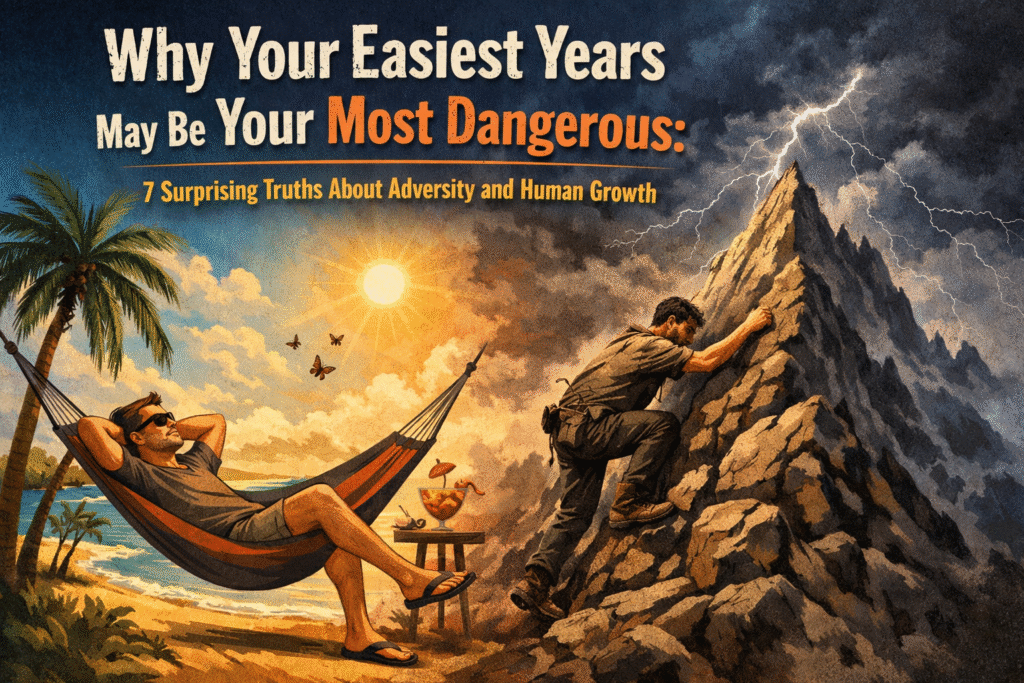
1. Having No Adversity Can Be Just as Damaging as Having Too Much
Here’s the finding that tends to stop people in their tracks: the research does not show that people with the least hardship do best. It shows that people with some hardship do best — and that people who have experienced almost no significant adversity in their lives are, in measurable ways, worse off than those who have faced moderate challenges.
Psychologist Mark Seery and his colleagues tracked 2,398 people over several years, measuring their cumulative lifetime exposure to adversity against ongoing markers of mental health, life satisfaction, and functional wellbeing. What they found was not a straight line trending downward as adversity increased. Instead, they found a U-shaped curve — or more precisely, an inverted-U — where people with moderate adversity consistently outperformed both those with high adversity and those with virtually no adversity at all.
A history of some lifetime adversity predicted relatively lower global distress, lower self-rated functional impairment, fewer post-traumatic stress symptoms, and higher life satisfaction over time — compared to both individuals who experienced high levels of adversity and individuals who experienced no adversity at all.
Why does this matter? Because it upends one of our most cherished assumptions — that the goal of a good life is to suffer as little as possible. The data suggests that the goal might actually be to suffer just enough to build the psychological infrastructure we’ll need when life inevitably gets harder. People who have never been tested, it turns out, lack the internal scaffolding to cope when testing finally arrives.
2. Past Hardship Acts Like a Psychological Vaccine
One of the most elegant ideas to emerge from resilience research is the concept of the “steeling effect” — the idea that moderate adversity doesn’t just leave you unchanged; it actively inoculates you against future stress.
Think of it like immunization. When a vaccine introduces a weakened pathogen into the body, the immune system mounts a defence, builds antibodies, and emerges more capable of handling the real thing. The steeling effect works on a similar principle: by navigating a manageable stressor, your psychological immune system learns what to do when the next one arrives.
When confronted with recent adverse events, people with a history of some prior lifetime adversity were the least negatively affected — in other words, individuals who had navigated moderate hardships in the past possessed a psychological buffer that mitigated the impact of new traumas.
“Just as the physical body requires the exertion of lifting weights to create micro-tears in muscle fibers that subsequently heal stronger, the psychological apparatus requires exposure to stress to develop cognitive and emotional toughness.”
This analogy is more than poetic — it’s biologically grounded. Without exertion, muscles don’t grow. Without challenge, the psychological stress-response system doesn’t calibrate. The vaccine logic holds: a controlled encounter with difficulty prepares you for the uncontrolled ones that follow.
The takeaway for daily life is striking. The setback you’re currently wrestling with — the difficult conversation, the professional failure, the period of financial strain — may be doing invisible, essential work on your behalf.
3. Resilience Is Not a Personality Trait — It’s a Skill You Build by Suffering (a Little)
One of the most persistent myths in popular psychology is the idea that some people are simply “resilient” and others aren’t — that it’s a fixed quality, like height or eye color, that you either have or you don’t. Research is unambiguous in overturning this.
Resilience is a dynamic process and a highly adaptive competency predicated on the very experience of hardship itself. By actively engaging with adversity, individuals develop a sophisticated repertoire of coping mechanisms, fortify their stress-responsive neurobiological systems, and cultivate profound shifts in perspective that empower them to endure future systemic shocks.
You cannot develop resilience in the absence of something to be resilient about. It’s not a latent quality waiting to be unlocked — it is built, incrementally, through the lived experience of challenge, discomfort, and recovery.
This reframing has profound implications. If resilience is learned, then the difficult chapters of your life aren’t just episodes to endure — they are the actual mechanism by which you become more capable. Every hard period you navigate with some degree of agency is, in a very literal sense, adding to your psychological strength.
It also means that shielding people — children especially — from every form of difficulty isn’t protection. It’s deprivation.
4. Your Brain Actually Rewires Itself in Response to Moderate Adversity
The neurobiological dimension of the Adversity Paradox is where things get genuinely fascinating. Researchers have identified two interrelated processes — tempering and fortification — that describe how the brain physically restructures itself when navigating moderate stress.
Tempering involves taking dormant or underused psychological and neurological skills and redeploying them in new, high-stakes contexts. When moderate adversity activates the body’s stress systems — specifically the HPA axis and the release of cortisol — it creates pressure that, if not overwhelming, doesn’t break the system. Instead, it modifies the system’s response capacity.
Tempering repairs, modifies, and strengthens the integrity of both neurobiological and psychosocial networks, producing a state of adaptive resilience.
Fortification, meanwhile, goes further: it is the acquisition of entirely new skills in response to environmental demands — new cognitive reframing techniques, new social networking behaviors, new emotional regulation strategies that didn’t exist in the person’s repertoire before the adversity arrived.
The crucial insight is that this only happens when the adversity is moderate. Too little stress, and the brain has no reason to adapt. Too much, and the system is overwhelmed before adaptation can occur.
For intense or prolonged types of adversity, intrinsic factors alone are grossly insufficient. In these instances, the individual is forced to mobilize additional resources to cope with current stressors, initiating the processes that “temper and fortify” the neurobiological architecture against future adversity.
The brain, it turns out, only upgrades itself under pressure.
5. Resilience Is a Community Effort, Not a Solo Achievement
Perhaps the most sociologically important insight from this body of research is this: the Adversity Paradox doesn’t work in isolation. It doesn’t work in a vacuum. The “steeling effect” only operates when there is sufficient structural and community support to keep adversity in the moderate zone — preventing it from tipping into the traumatic.
Sociologist Phillip Bowman’s work on African American families illustrates this with particular clarity. Studying communities that had achieved remarkable educational and professional advances despite facing profound systemic adversity, Bowman found that individual psychological resilience was almost always nested within something larger.
People can grow exponentially stronger by confronting and mastering adversity, but with a crucial sociological caveat: this growth is heavily contingent upon being supported by strong, multi-level family, community, and cultural support systems.
The specific protective factors identified in this research are worth naming: strong racial identity, deliberate community socialization, a positive outlook, spirituality, meaning-making in the face of adversity, communal connectedness, open emotional expression, empathy, compassion, forgiveness, and cultural rituals of remembrance.
These aren’t soft factors. They are the catalysts that convert potentially traumatic stress into manageable, growth-producing adversity.
“Hardship creates growth only when the individual possesses, or can access, the structural scaffolding necessary to process it.”
This is a reminder that resilience is not simply a matter of individual willpower or personal toughness. It is, at its core, a relational achievement. The communities, families, mentors, and networks that surround a person in difficulty are not auxiliary to their resilience — they are constitutive of it. Building resilient individuals requires building resilient communities first.
6. Resilience Has a Hidden Physiological Price Tag — Especially Under Chronic Stress
Here’s the uncomfortable addendum to the Adversity Paradox: while moderate, episodic adversity builds strength, chronic systemic adversity — even when a person appears psychologically resilient on the outside — may be quietly depleting their biology on the inside.
Researchers studying adolescents in high-risk, high-adversity environments found something deeply sobering. These young people demonstrated impressive external resilience — high behavioral adaptation, strong academic performance, clear psychological functioning. But beneath that surface:
While these individuals may display extraordinarily high levels of external resilience and behavioral adaptation to severe systemic adversity, this constant adaptation requires immense, chronic physiological effort. The continuous activation of the allostatic load to temper and fortify against constant sociological stress can eventually compromise underlying biological health metrics.
In other words, the body keeps score. Sustained psychological resilience in the face of ongoing systemic adversity — poverty, discrimination, instability — may come at a biological cost that doesn’t show up in psychological assessments but does show up in cardiovascular health, immune function, and long-term physical wellbeing.
This finding carries a critical ethical implication: celebrating the resilience of people facing chronic, systemic adversity without working to address the systems that generate that adversity is not enough. True support means both equipping people to cope and working to reduce the load they’re asked to carry.
The Adversity Paradox is not an argument for letting difficult circumstances persist. It is an argument for understanding how humans survive and grow despite them — and for doing more to ensure they don’t have to.
7. The Digital Age Is Accidentally Engineering a Generation Ill-Equipped for Difficulty
The final takeaway may be the most urgent for our current moment. The very features that define contemporary life — algorithmic comfort, infinite entertainment, the engineering of frictionless experience, the curation of idealized online realities — are quietly undermining the natural development of resilience.
Current societal trends heavily emphasize instant gratification, algorithmic comfort, and the avoidance of friction, fundamentally undermining the natural development of essential life skills related to coping with hardship. By engineering environments virtually devoid of normative daily adversity, society denies its youth the micro-stressors necessary for psychological tempering.
The attention economy is, in this sense, a resilience economy too — and it is extracting value from us by trading away our capacity for difficulty. Every time an algorithm smooths out a frustrating wait, optimizes away a moment of boredom, or curates away a perspective that challenges us, it removes a small but meaningful opportunity for psychological calibration.
Modern psychological literature suggests that the therapy industry must pivot away from therapeutic models that foster dependency and pathologize natural negative emotions. Instead, there is a vital need to emphasize resilience-building, social connection, and informal peer community support, thereby artificially recreating the optimal conditions under which the Adversity Paradox flourishes.
This isn’t a call for a return to some imagined harder era. It’s a call for intentionality — for parents, educators, therapists, and organizational leaders to recognize that occasional discomfort, productive struggle, and the experience of working through difficulty are not things to be engineered away. They are things to be thoughtfully preserved.
A child who is never allowed to fail at something manageable will be less equipped to recover from something significant. An adult who optimizes their life for comfort will be less prepared when comfort is no longer available. The friction we instinctively resist may be precisely what we need.
The Final Thought
The Adversity Paradox doesn’t romanticize suffering. It doesn’t suggest that trauma is good, that hardship should be sought, or that systemic injustice should be celebrated as a character-builder. The research is clear: too much adversity is devastating, and chronic systemic stress carries real costs that no amount of individual resilience can fully offset.
What the paradox does offer is something quietly radical: a re-evaluation of our relationship with difficulty. Not every hard season is a wound. Some are immunizations. Not every failure is damage. Some are exactly the micro-stress that the psychological system needed in order to adapt, grow, and prepare.
The science now affirms what many wisdom traditions have long intuited — that growth does not happen in the absence of challenge. It happens because of it. The human being is not a fragile vessel to be insulated from the world. It is a dynamic, adaptive system that becomes more capable in direct proportion to what it is asked to face — provided it is surrounded by community, equipped with the tools to make meaning, and not pushed beyond the breaking point.
The question worth sitting with, then, is this:
Which difficulties in your life — the ones you’ve been trying hardest to escape — might actually be the very experiences quietly forging your greatest strengths?
Tripta Foundation is committed to promoting holistic wellness, psychological resilience, and community wellbeing. Explore more at triptawellness.com.