
Let’s be honest—conflict is as Indian as paneer tikka, traffic jams, and aunties asking about your marriage plans. Whether it’s deciding which restaurant to visit on your parents’ anniversary (because apparently, that’s mandatory fight time), debating whether to order Shahi Paneer or Paneer Pasanda, or navigating the eternal saas-bahu dynamics that have fueled countless TV serials, we’re all intimately familiar with the art of disagreement.
But here’s the thing: not all of us handle conflict the same way. Some of us charge in like warriors ready for battle, while others retreat faster than you can say “family WhatsApp group drama.” The truth is, we each have our own conflict management style—our default mode when tensions rise and tempers flare.
What if I told you that your conflict style could be represented by an animal? No, this isn’t some random personality quiz you’d find on Instagram at 2 AM. This is backed by actual conflict management research, and it’s surprisingly accurate. So, let’s dive into the animal kingdom of conflict and discover which creature you become when the conflict begins.
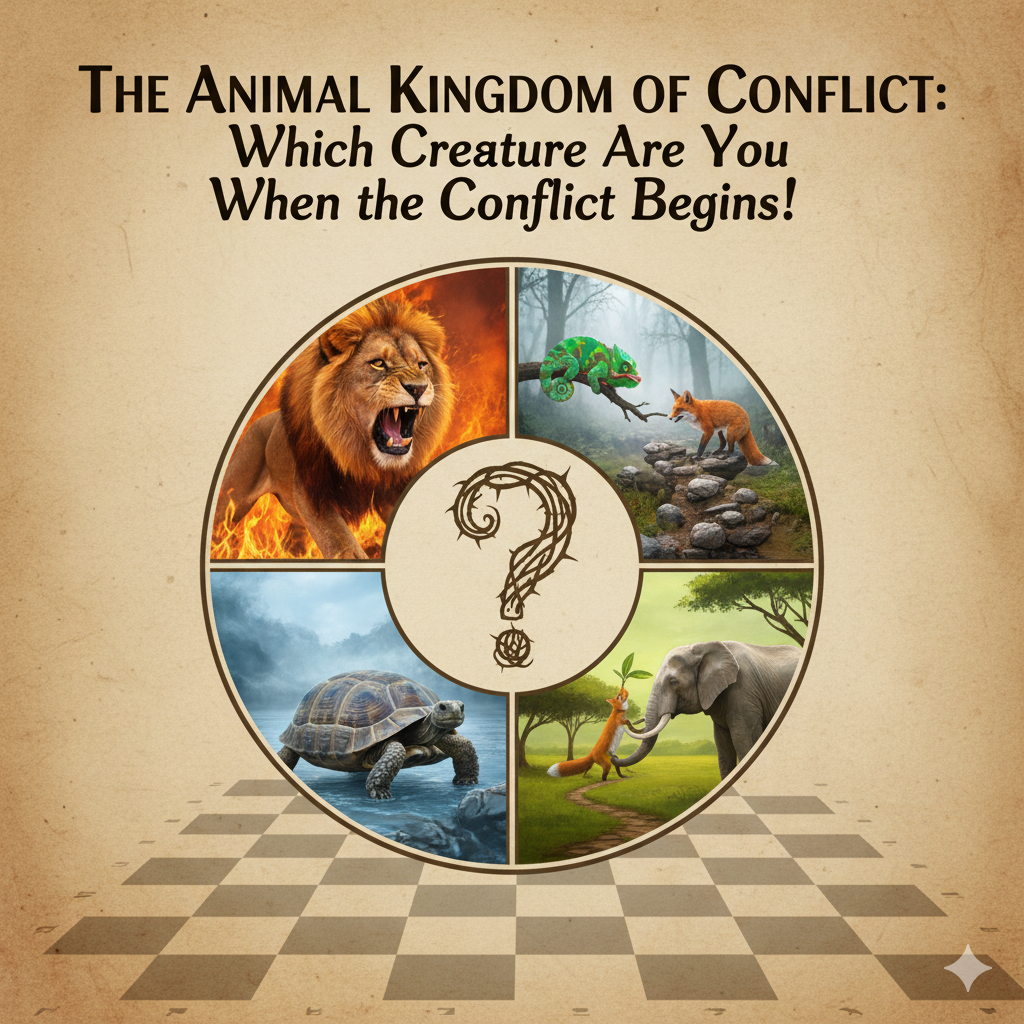
The Owl: The “I Win, You Win” Collaborator
Picture this: It’s a Sunday afternoon, and your joint family of 22 people needs to decide where to go for dinner. Uncle wants Chinese, Aunty insists on South Indian, the kids are screaming for pizza, and Dadi wants home-cooked food. While everyone else is ready to throw hands, there’s one person calmly sitting there, notebook in hand, trying to find a solution that makes everyone happy.
That’s your Owl.
Owls are the diplomats of the conflict world. They highly value both their own goals AND their relationships with others. To an Owl, conflict isn’t a battle to be won—it’s a problem to be solved. They’re the ones who’ll suggest, “Why don’t we order a thali that has a bit of everything?” or “What if we go somewhere with a diverse menu so everyone gets what they want?”
In the Indian workplace, Owls are the colleagues who mediate between the boss who wants the presentation done “their way” and the team that has a different vision. They’re not satisfied with quick fixes or Band-Aid solutions. They want to dig deep, understand everyone’s concerns, and find that golden middle ground where both parties genuinely feel heard and satisfied.
When to channel your inner Owl: When the relationship matters as much as the outcome. When you’re dealing with family dynamics, long-term business partnerships, or any situation where burning bridges would be more expensive than finding common ground. Research shows that Indian professionals actually prefer this approach-based, collaborative strategy over avoidance, particularly valuing negotiation and consensus-building that aligns with our collectivist culture.
The catch? Being an Owl takes time, patience, and emotional energy. You can’t Owl your way through every conflict—sometimes you just need to pick a restaurant and move on with life.
The Turtle: The “I Zig, You Zag” Avoider
We all know a Turtle. Actually, if we’re being honest, most of us ARE the Turtle at some point, especially in awkward family situations.
Turtles withdraw into their shells at the first sign of conflict. They’re the ones who suddenly remember they have an urgent phone call when two relatives start arguing about politics. They’re the employee who says “whatever you think is best” even when they strongly disagree. They give up both their goals and their relationships because, in their mind, avoiding the conflict is easier than facing it.
In Indian families, Turtle behavior is almost an art form. Don’t want to confront your mother-in-law about her constant interference? Just smile, nod, and quietly do things your way when she’s not looking. Annoyed that your colleague took credit for your work? Well, creating a scene would be so uncomfortable, so you just… let it go. And go. And go.
The problem? Being a Turtle might keep the peace temporarily, but it’s like sweeping dust under a carpet—eventually, someone’s going to trip over that lump.
When to channel your inner Turtle: When the issue is genuinely trivial (like whether to have chai or coffee), when emotions are running too high and everyone needs a cooling-off period, or when you’re simply too exhausted to deal with another drama. Sometimes, strategic withdrawal isn’t cowardice—it’s self-preservation.
The catch? Chronic Turtle behavior leads to resentment, passive-aggressive behavior, and those explosive fights that seemingly come out of nowhere. Also, people might mistake your silence for agreement, which can backfire spectacularly.
The Shark: The “I Win, You Lose” Competitor
Every Indian office has that one Shark—the colleague who treats every project like it’s Kaun Banega Crorepati and they’re going for the jackpot. Every family has one too—usually that uncle who MUST win every argument, even if the topic is as ridiculous as whether tomatoes are fruits or vegetables.
Sharks try to overpower opponents by forcing them to accept their solution to the conflict. Their goals are highly important to them, while relationships? Meh, those are of minor importance. They don’t particularly care if others like or accept them—they just want to WIN. For Sharks, winning gives them a sense of pride and achievement, while losing feels like weakness and failure.
In Indian workplaces, male Baby Boomers often display this confrontational, win-lose orientation more than younger generations. The Shark boss is the one who says, “It’s my way or the highway,” who makes unilateral decisions, and who measures success by how many battles they’ve won rather than how many relationships they’ve built.
But here’s the twist—sometimes, you NEED to be a Shark. When moral principles are at stake, when someone is being harassed, when a decision needs to be made quickly in a crisis, channeling your inner Shark can be exactly what the situation demands.
When to channel your inner Shark: Emergency situations, when you’re absolutely certain you’re right and compromise would be dangerous or unethical, when you’re dealing with someone who only understands dominance, or when you need to establish boundaries with people who keep crossing lines.
The catch? Overuse of the Shark style damages relationships irreparably. You might win the battle but lose the war. In our relationship-oriented Indian culture, being known as someone who bulldozes over everyone can isolate you faster than you can say “family function canceled”.
The Teddy Bear: The “I Lose, You Win” Accommodator
Ah, the Teddy Bear—the sweetest, most self-sacrificing creature in our conflict zoo. Teddy Bears place enormous importance on relationships while their own goals take a backseat. They’re the people who want to be liked and accepted SO badly that they’ll give up what they want just to keep the peace.
In Indian society, women are often conditioned to be Teddy Bears, expected to make the majority of personal compromises to maintain harmony. The wife who gives up her career because the husband’s job is “more important.” The daughter-in-law who silently tolerates disrespect because confrontation might “damage the relationship”. The friend who always chooses what the group wants, never what they want.
Teddy Bears believe that conflict should be avoided in favor of harmony and that people can’t discuss conflicts without damaging relationships. Their mantra? “I’ll give up my goals and let you have what you want, so you’ll like me”.
When to channel your inner Teddy Bear: When you genuinely don’t care much about the outcome but you care deeply about the person, when preserving harmony is temporarily more important than your preference, or when you’re wrong and need to gracefully back down.
The catch? Chronic Teddy Bear behavior leads to burnout, resentment, and loss of self. People start taking advantage of you, and eventually, you might explode in unexpected ways. Remember—setting boundaries doesn’t make you selfish; it makes you sustainable.
The Fox: The “You Bend, I Bend” Compromiser
The Fox is that friend who’s always suggesting, “Let’s meet halfway.” They’re moderately concerned with their own goals AND their relationships—basically, they want everyone to give a little to gain a little.
In Indian families, the Fox is the person who says, “Okay, we’ll visit your parents this Diwali and mine during Holi.” They’re the ones negotiating: “You choose the movie, I’ll choose the restaurant.” They seek the middle ground between two extreme positions, willing to sacrifice part of their goals and relationships to find agreement for the common good.
The Fox style is sometimes called “lose-lose” because neither side gets exactly what they want. But it’s also highly practical—it’s how most Indian marriages survive (“You go for your boys’ night out, but only after the family dinner”), how work teams function (“We’ll do half the presentation your way and half mine”), and how we navigate daily life in a country of 1.4 billion people with different opinions.
When to channel your inner Fox: When both sides have equally important but conflicting needs, when you need a quick solution and perfection isn’t critical, when you’ve tried collaboration but it’s taking too long, or when the relationship and the goal are moderately important but not worth dying on that hill.
The catch? Too much compromising means nobody is truly satisfied. Sometimes, creative solutions exist where BOTH parties can get what they want (Owl style), but Fox-style compromising settles for less before fully exploring those options.
The Real World: When Animals Collide
Here’s where it gets interesting—and very, very Indian. Most conflicts don’t involve just one animal style. They’re chaotic zoos where different creatures clash.
Imagine this scenario: A young couple in Bangalore is discussing where they’ll live after marriage. The groom wants to stay with his parents (he’s being a Teddy Bear to his family but a Shark with his fiancée). The bride wants a separate apartment (she’s trying to be an Owl, seeking a solution where they can maintain relationships with family while having their own space). His parents are being Sharks, insisting on tradition. Her parents might be Foxes, suggesting they live separately but in the same building. And the couple’s younger siblings? Probably Turtles, avoiding the whole mess entirely.
Indian families are particularly skilled at this multi-animal chaos. Research shows that elder-led conflict resolution in traditional Indian households often employed Owl tactics—creating safe spaces for dialogue, maintaining neutrality, fostering empathy, and drawing on cultural and spiritual references to guide couples toward mutual understanding. Modern families, though? We’re navigating conflicts with less structured support and more individual agency, which means we need to be MORE intentional about our conflict styles, not less.
So, Which Animal Should You Be?
The million-rupee question: Is there a “best” style?
Research suggests that the collaborating (Owl) style is most effective for long-term relationship satisfaction and sustainable solutions. In the Indian workplace, professionals prefer approach-based strategies—particularly negotiation and collaboration—over avoidance. The collaborative approach aligns beautifully with our collectivist culture that emphasizes group decision-making and consensus.
BUT—and this is crucial—conflict management isn’t one-size-fits-all. The most emotionally intelligent people are style-shifters. They can be Owls when it matters, Turtles when they need to preserve energy, Sharks when principles are at stake, Teddy Bears when showing grace, and Foxes when time is short.
Becoming a Conflict Management Shapeshifter: Practical Tips
1. Know thyself (and thy animal). The first step is recognizing your default style. Do you always cave (Teddy Bear)? Do you always compete (Shark)? Do you disappear at the first sign of tension (Turtle)? Awareness is power.
2. Assess the situation before reacting. Ask yourself: How important is this issue to me? How important is this relationship? How much time do I have? Your answers should guide which animal you channel.
3. Practice active listening. Whether you’re being an Owl, Fox, or even a Shark, actually hearing what the other person needs (not just what they’re saying) changes everything. In our loud, chaotic Indian households and offices, the skill of truly listening is revolutionary.
4. Communicate openly—but respectfully. Indian culture sometimes equates directness with rudeness, but there’s a middle ground. You can express your needs clearly while maintaining respect for the other person. It’s not WHAT you say; it’s HOW you say it.
5. Focus on interests, not positions. This is classic Owl behavior. Instead of fighting over WHAT you want, discuss WHY you want it. Often, there are creative solutions that meet both parties’ underlying interests.
6. Know when to bring in mediators. Sometimes, we need that elder figure, that neutral friend, or that HR person to help facilitate the conversation. There’s wisdom in traditional Indian conflict resolution that involved respected elders creating safe spaces for dialogue. We can honor that tradition while adapting it to modern contexts.
7. Develop emotional intelligence. Understanding and managing your own emotions, and empathizing with others’ emotions, is the foundation of effective conflict management. When we can say, “I’m feeling frustrated because…” instead of “You always…,” we’re already winning.
8. Remember: Conflict isn’t always bad. Indian culture often treats conflict as something to be avoided at all costs. But research shows that well-managed conflict can strengthen relationships, spark innovation, and lead to better solutions. The goal isn’t to eliminate conflict—it’s to handle it skillfully.
A Final Thought: The Wisdom of Conflict
There’s a brilliant observation in content creator Yuvraj Dua’s work about Indian families: “It’s not love that holds us together. It’s the constant conflict that makes us inseparable. Because apart from us, we cannot see anyone else”.
There’s profound truth in that humor. Conflict is part of intimacy. The ability to disagree, to navigate differences, to fight and make up—these are signs of robust relationships, not weak ones. The problem isn’t that we have conflicts; it’s that we often handle them poorly.
Whether you’re dealing with that invasive aunty asking about your salary, that colleague who keeps stealing your ideas, that spouse who INSISTS on watching one more episode when you want to sleep, or that in-law who criticizes your cooking despite eating three servings—remember: you have options. You’re not stuck being one animal forever.
Sometimes you’ll be an Owl, patiently working toward win-win solutions. Sometimes you’ll be a Turtle, wisely choosing your battles. Sometimes you’ll be a Shark, fiercely protecting your boundaries. Sometimes you’ll be a Teddy Bear, showing grace and generosity. And sometimes you’ll be a Fox, finding that pragmatic middle ground.
The key is conscious choice. Don’t let your default animal control you—learn to shapeshift according to the situation. Because in the beautifully chaotic, wonderfully complex, perpetually dramatic landscape of Indian life—from family WhatsApp groups to corporate boardrooms, from wedding planning to festival celebrations—the ability to manage conflict skillfully isn’t just a nice-to-have skill.
It’s survival.
So the next time a conflict begins, pause and ask yourself: Which animal does this situation need? Then, channel that creature with intention, wisdom, and maybe just a tiny bit of humor.
After all, if we can’t laugh at our conflicts, we’re taking ourselves way too seriously. And in India, where conflicts can arise over everything from cricket teams to caste politics to whether rotis should be round or oval, a sense of humor might just be the most important conflict management tool of all.