
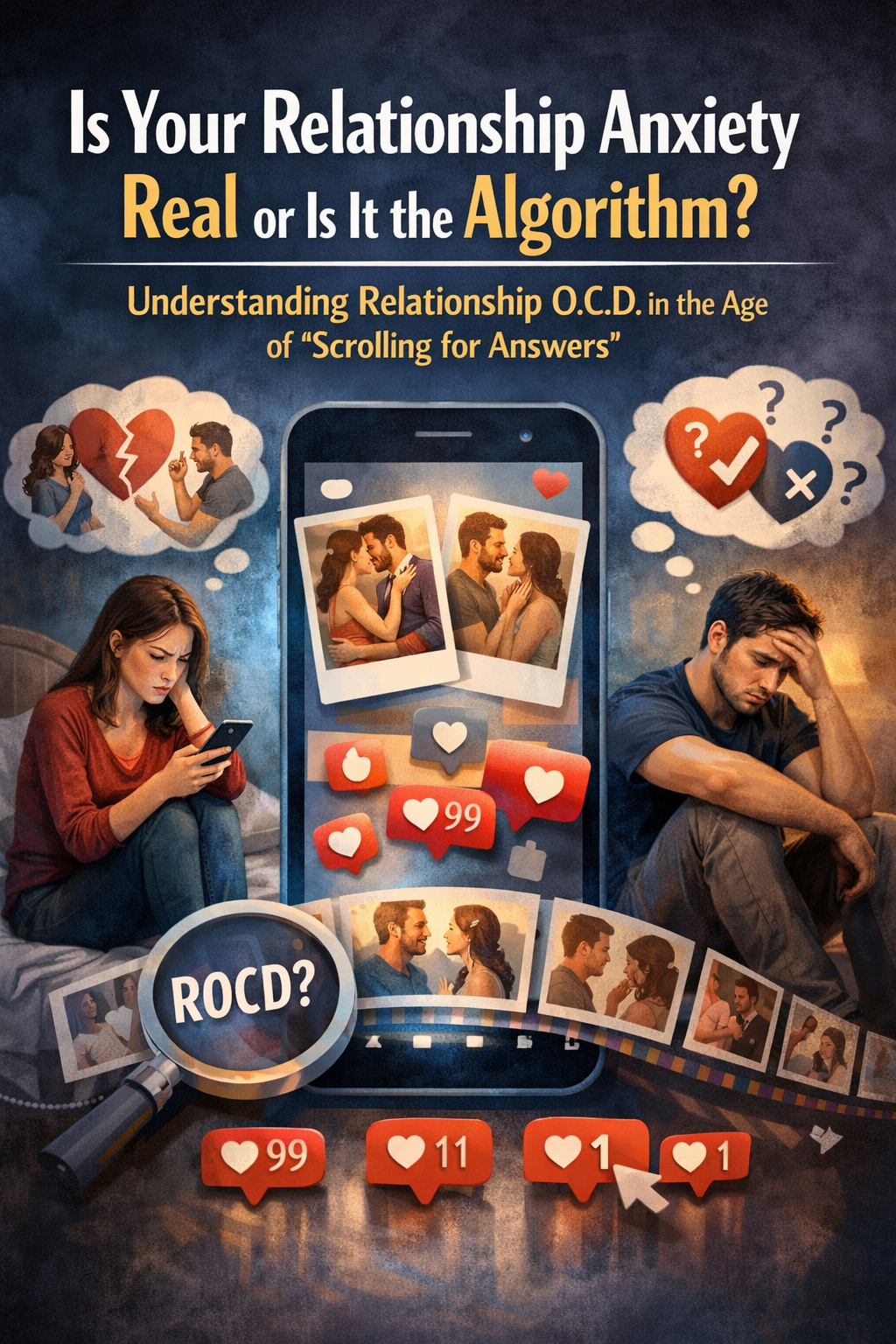
Introduction: The Modern Ritual of “Googling” Love
It starts innocently enough. You’re lying in bed, the glow of your phone illuminating the ceiling, and a thought creeps in: “Did they seem distant at dinner?”
Ten years ago, you might have rolled over, discussed it in the morning, or simply let the thought pass. Today, the ritual is different. You open a search engine or a social media app. You type in: “Signs my partner is losing interest,” or “Is it normal to not feel ‘the spark’ every day?”
Three hours later, you are deep in a rabbit hole of forum threads, TikTok videos about “micro-cheating,” and checklists of “toxic traits” that seem to confirm your worst fears. You feel a knot in your stomach—not because your relationship is failing, but because the internet has convinced you that uncertainty is a danger signal.
There is a significant rise in what clinicians call Relationship Obsessive-Compulsive Disorder (ROCD). While not a standalone diagnosis in the DSM-5, ROCD is a widely recognized and debilitating manifestation of OCD where the “obsessions” center on one’s partner or the relationship itself.
In a world where algorithms are designed to keep us clicking on fears and insecurities, ROCD is no longer just a niche psychological concept—it is a growing mental health crisis. This post explores how the digital age fuels relationship anxiety, how to distinguish normal doubt from obsessive patterns, and how we can reclaim our peace of mind.
Defining the Ghost: What is Relationship O.C.D. (ROCD)?
To understand ROCD, we must first distinguish it from the typical ups and downs of romantic life. Every relationship has moments of doubt. We all wonder, occasionally, if we are with the “right” person or if our partner is truly happy.
ROCD transforms these common questions into intrusive, relentless, and distressing loops of thought. It is characterized by two main components:
- Obsessions: Unwanted, intrusive thoughts, images, or urges that cause significant anxiety.
- Partner-Focused: Obsessing over a partner’s physical flaws (e.g., “Is their nose too big?” “Do they laugh weirdly?”) or personality traits (e.g., “Are they intelligent enough for me?”).
- Relationship-Focused: Obsessing over the “rightness” of the bond (e.g., “Do I love them enough?” “Is this the ‘perfect’ love described in movies?”).
- Compulsions: Repetitive behaviors performed to reduce the anxiety caused by the obsessions.
- Checking: Constantly monitoring your own body for physical arousal or feelings of “love” when you are with your partner.
- Comparison: Compulsively comparing your relationship to others (friends, exes, or influencers).
- Reassurance Seeking: Asking friends, family, or the internet repeatedly if the relationship seems “okay.”
The cruelty of ROCD lies in its target: it attacks what you value most. The more you care about your partner, the more terrifying the intrusive thought “What if I don’t actually love them?” becomes.
The Digital Amplifier: How Social Media Feeds the Fire
If ROCD is the fire, the modern internet is the gasoline.
ROCD symptoms are directly exacerbated by their digital consumption. The mechanisms are subtle but powerful.
The “Compare and Despair” Trap
Social media platforms are curated highlights reels. When a person with ROCD scrolls through Instagram and sees a couple posting a “perfect” anniversary tribute, their brain doesn’t register the staged lighting or the argument that happened five minutes before the photo was taken. Instead, the ROCD brain registers a deficit: “Look how happy they look. I didn’t feel that explosive joy this morning. Does that mean I’m in the wrong relationship?”
This constant comparison creates a distorted baseline for what love “should” look like—consistent, euphoric, and flawless—which is a standard no real human connection can meet.
The “Red Flag” Economy
Content creators are incentivized to create engagement, and fear drives engagement. This has led to an explosion of content analyzing “red flags,” “toxic traits,” and “narcissistic abuse.” While awareness is good, for the ROCD sufferer, this content is a minefield.
A simple, human mistake by a partner (e.g., forgetting to text back immediately) is no longer just a mistake; through the lens of a 60-second viral video, it becomes a sign of “avoidant attachment” or “lack of respect.” The sufferer begins to pathologize normal human imperfections, convinced they are missing a crucial warning sign.
Algorithmic Reinforcement
The most dangerous aspect is the algorithm itself. If you pause to watch one video about “Signs your relationship is over,” the algorithm notes your interest. Within days, your feed is flooded with content reinforcing doubt. You are literally being fed a personalized narrative that your relationship is doomed, creating a self-fulfilling prophecy of anxiety.
The Cycle of Reassurance Seeking: Why “Googling It” Makes It Worse
The most common compulsion we see today is “digital reassurance seeking.”
When an intrusive thought hits—“What if we have nothing in common?”—the immediate urge is to find an answer that dissolves the anxiety. You Google. You read forums. You take online quizzes: “Is he the one?”
For a brief moment, finding a reassuring article feels like relief. The anxiety drops. But this relief is short-lived.
Here is the trap: By engaging with the intrusive thought (by researching it), you are signaling to your brain that the thought is important and dangerous. You are validating the false alarm.
The next time the thought arises, it comes back stronger, demanding even more “proof” that everything is okay. The threshold for certainty raises higher and higher until no amount of Googling can satisfy it. We call this the “Reassurance Trap.” You cannot think your way out of an obsessive loop; you can only act your way out by breaking the cycle of compulsion.
The Hidden Impact on Partners
While the sufferer is wrestling with their internal storm, the partner often stands in the rain, confused and hurt.
ROCD can be deeply painful for the partner, who may feel:
- Scrutinized: Feeling like they are constantly under a microscope, being judged for their appearance, intelligence, or habits.
- Rejected: Misinterpreting the sufferer’s anxiety or withdrawal as a lack of love.
- Exhausted: Being asked constantly, “Are we okay?” “Do you think we’re a good match?” “Did you really mean what you said?”
We emphasize that ROCD is not a “relationship problem” in the traditional sense—it is an anxiety problem about the relationship. However, if left untreated, the constant confession of doubts (“I’m just not sure if I’m attracted to you right now”) can erode the trust and intimacy that forms the foundation of the bond.
It is crucial for partners to understand that these doubts are not reflections of reality, but symptoms of a cognitive distortion.
Breaking the Cycle: Strategies for Managing ROCD in a Digital World
Recovery from ROCD is possible, but it requires a counter-intuitive approach. We must learn to tolerate uncertainty rather than trying to eliminate it.
Here are actionable strategies we recommend at Tripta Foundation:
Step 1: The Digital Detox (Selective Pruning)
You cannot heal in the same environment that made you sick.
- Mute or Unfollow: Ruthlessly mute accounts that trigger comparison or anxiety. If a “relationship coach” makes you question your marriage, unfollow them.
- Limit Search Engines: Put a strict ban on Googling relationship symptoms. If an urgent question arises, write it down and agree to wait 24 hours before researching it. Often, the urgency fades.
Step 2: Labeling the Thought
When the thought “What if I don’t love him?” pops up, do not argue with it. Do not try to prove it wrong. Instead, simply label it: “I am having an intrusive thought that I don’t love him.” This small linguistic shift creates distance between you (the observer) and the thought (the mental noise).
Step 3: ERP (Exposure and Response Prevention)
This is the gold standard for OCD treatment. It involves exposing yourself to the fear without performing the compulsion.
- Example: Sit with the thought “Maybe I’m in the wrong relationship” for 10 minutes without asking your partner for reassurance, checking old photos, or Googling symptoms.
- Allow the anxiety to be there. Watch it rise, peak, and eventually fall on its own. This teaches your brain that the thought is not a genuine threat.
Step 4: Shift from “Feeling” to “Doing”
ROCD places immense pressure on feelings. “Do I feel a spark?” “Do I feel 100% sure?” Feelings are fickle; they fluctuate with hunger, sleep, and stress. Instead, focus on values.
- Are you showing up as the partner you want to be?
- Are you engaging in acts of kindness?
- Love is a verb, not just a sensation. Commit to the actions of love, even when the feelings of anxiety are present.
The Tripta Foundation Approach: Holistic Recovery
At Tripta Foundation, we view mental health through a lens that integrates clinical rigor with holistic wellness. We understand that ROCD is rarely just about the relationship; it is often tied to deeper patterns of perfectionism, fear of loss, and a nervous system that is stuck in “fight or flight.”
Our approach involves:
- Psycho-education: Helping clients and their families understand the mechanics of OCD so they stop fighting the wrong battle.
- Cognitive Behavioral Strategies: Tools to identify and dismantle the cognitive distortions fueling the anxiety.
- Mindfulness & Somatic Practices: Techniques to regulate the nervous system, reducing the physical urgency of the anxiety.
- Couples Counseling: Creating a safe container for partners to understand the disorder and learn how to support their loved one without feeding the compulsions.
We believe that a relationship does not need to be “perfect” to be wonderful. In fact, the pursuit of perfection is often the enemy of true connection.
Conclusion: Embracing the “Good Enough”
In an age of digital perfection, accepting a “human” relationship is a radical act.
Your partner will have flaws. You will have days where you feel distant. There will be moments of boredom. This is not evidence of a failed relationship; it is evidence of a real one.
If you find yourself trapped in the endless scroll of relationship anxiety, remember this: The answer you are looking for is not on a screen. It is not in a forum thread or a TikTok video.
Certainty is a myth. But connection—messy, imperfect, real connection—is something you build, day by day, offline.
Put the phone down. Look at the person in front of you. And choose to be present, doubts and all.
Next Steps: How Tripta Can Help
If the cycle of intrusive thoughts and reassurance seeking feels overwhelming, you do not have to navigate it alone. ROCD is highly treatable with the right support.
- Read More: Explore our resource library on Managing Anxiety and Intrusive Thoughts for more practical tools.
- Take Action: If you are ready to break the cycle, contact Tripta Foundation today to schedule a consultation with one of our specialists. We offer both individual therapy and couples support tailored to your unique needs.
Let us help you find your footing again—not in certainty, but in confidence.