
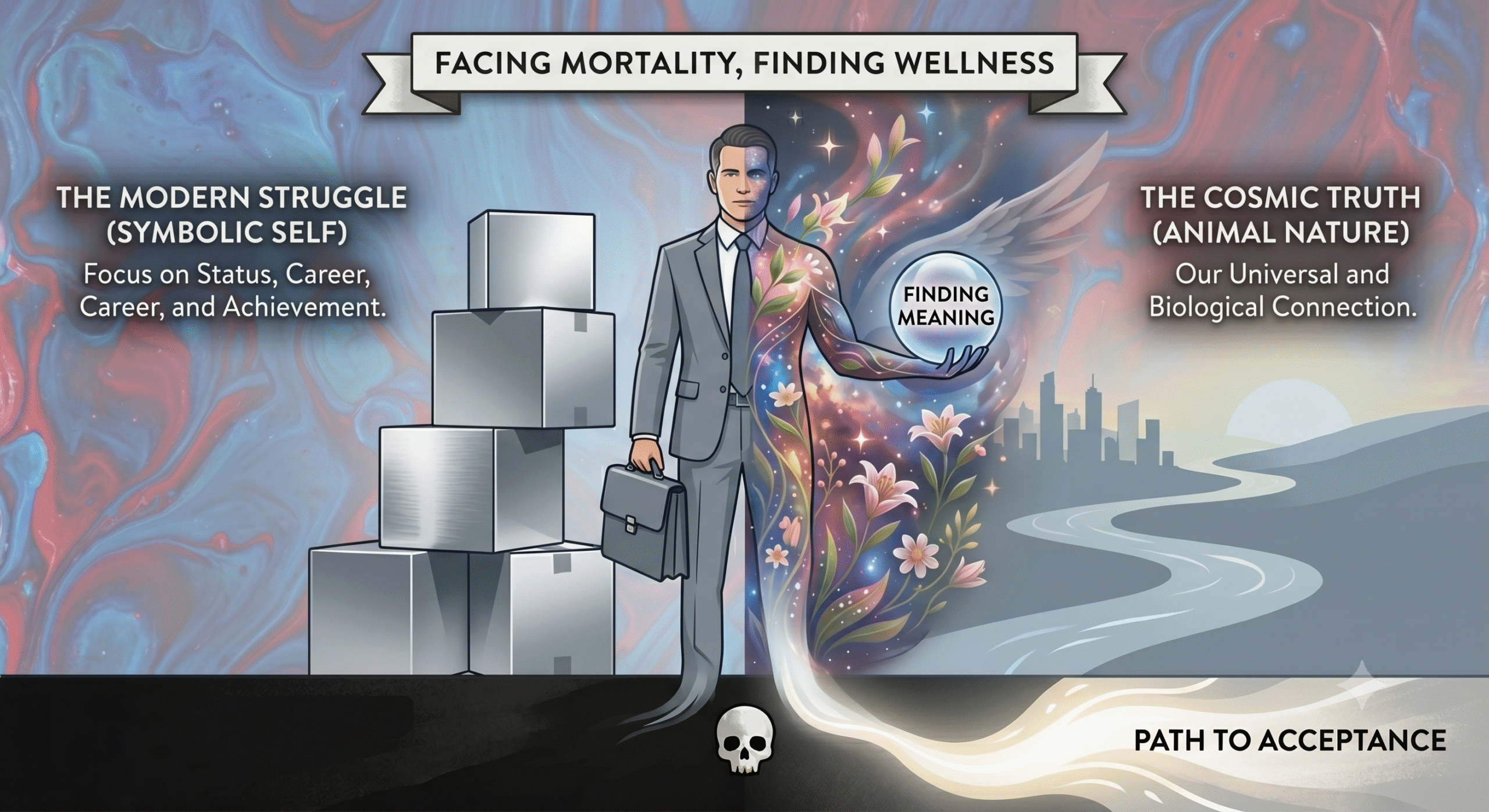
Welcome back to the Tripta Wellness blog. Today, we are going to explore a topic that might seem a little heavy for your morning commute or your lunch break, but it is one that quietly dictates almost every single decision you make: death.
Death is a theme that has haunted human thought for millennia. From the ancient world to modern times, philosophers, poets, and thinkers have endlessly grappled with the inescapable end that awaits us all. History is absolutely filled with reflections on mortality, offering examples that have become emblematic of our daily struggle to find meaning in the face of death. Take, for instance, the trial and death of Socrates—a moment immortalized in philosophy. Socrates’ calm acceptance of his fate and his willingness to face death with profound composure offers one of the earliest and greatest examples of confronting mortality. It poses a fundamental question: what does it actually mean to live a life of integrity when death looms over everything we do?
In the modern era, there is the existentialist perspective, which forces us to confront our mortality in a much more personal, and perhaps deeply unsettling, way. As human beings, we are faced with a stark, binary choice: we can either despair over the absolute certainty of death, or, as the philosopher Søren Kierkegaard suggests, we can take a “leap of faith”. This leap, in Kierkegaardian terms, involves placing our trust in the sacrosanct vitality of the cosmos—in the mysterious forces of life, evolution, and the divine—even though they completely remain beyond our full understanding.
This is exactly where Ernest Becker’s Pulitzer Prize-winning book, The Denial of Death, enters the picture. While Becker was not a philosopher in the traditional sense, his groundbreaking work engages deeply with both philosophical and psychological traditions. Becker’s central, paradigm-shifting thesis is the following: all of human behavior, our endless craving for meaning, our cultural practices, and our deep-seated anxieties arise from an unconscious fear of death. He argues that we deny death, and this very denial shapes the entire structure of our societies. By creating elaborate systems—whether they be religious, cultural, or psychological—we actively attempt to distract ourselves from the terrifying, undeniable reality of our own mortality.
In this post, we will dive into Becker’s bold ideas about how humans cope with the fear of death, explore how his work connects with the rich history of philosophical thought, and importantly, examine how this unconscious fear deeply impacts the psychology and daily life of the modern working man.
The Paradox of Being Human
To understand why we run from our mortality so aggressively, we first have to understand what makes us human. For centuries, philosophers have searched for the “essence” of man, hoping to discover some unique substance or special quality that makes human beings distinct. But as Becker points out, leaning on Erich Fromm and other influential thinkers, man actually has no single essence. What makes us unique is precisely our paradoxical nature: humans are half animal and half symbolic.
This idea, which traces all the way back to Kierkegaard’s book The Concept of Anxiety, captures the central paradox of our human existence. On one hand, we absolutely share the biological, animalistic nature of all other living creatures. We are heavily driven by survival, physical needs, and raw instinct. But on the other hand, we possess something vastly more complex: a symbolic identity and a profound self-awareness that allows us to reflect on our own existence and actively project meaning into the world around us.
Tragically, it is this very awareness that curses us with the knowledge of our own mortality—a heavy, burdensome knowledge that no other animal on Earth has to bear. The origin of this idea traces back to Kierkegaard’s brilliant analysis of the biblical Adam and Eve myth, where the “original sin” of eating the fruit of knowledge represents the dawning of human self-consciousness, which is fundamentally the awareness of death. This existential awakening burdens man with a highly unique form of suffering. He becomes intimately aware not only of his life, but also of his inevitable, unavoidable death.
Man’s ultimate tragedy lies in his dual ability to live in two completely different worlds simultaneously: the animal world, where survival is the only true concern, and the symbolic world, where meaning, identity, and the denial of death completely dominate his thoughts. Becker encapsulates this agonizing dilemma perfectly:
“Man is literally split in two: he has an awareness of his own splendid uniqueness in that he sticks out of nature with a towering majesty, and yet he goes back into the ground a few feet in order blindly and dumbly to rot and disappear forever.”
It is a genuinely terrifying dilemma to be in, and having to live with this dual nature is a source of constant, grating psychological conflict. Humans are so aware of their splendid uniqueness, carrying the sense that they are much more than mere animals, and that their lives are deeply significant in some unique, cosmic way. Yet, despite this grand sense of importance, they must ultimately return to the ground, entirely indistinguishable from any other decaying organism. This stark contradiction is at the very heart of the human condition, and it is no wonder that for many, simply contemplating this thought could drive them to pure despair or even madness. As the French philosopher Blaise Pascal so aptly describes it, men are so necessarily mad that not to be mad would amount to another, entirely different form of madness.
The Heroic Project: Our Armor Against the End
Faced with this terrifying reality, human life is largely dedicated to escaping this knowledge. The existential dualism—the violent clash between our symbolic selves and our raw, animal mortality—creates an impossible situation for the human mind to reconcile. It is a problem without a tangible solution, an excruciating dilemma that haunts us daily. To survive it, we engage in what Becker calls the “hero project”.
Becker’s understanding of this concept stems deeply from his understanding of human development, particularly through the groundbreaking work of Sigmund Freud and Otto Rank. Freud, the legendary father of psychoanalysis, introduced the idea that a child’s early psychological development is heavily driven by the quest for security and self-worth. From the moment of birth, the infant is utterly helpless and completely dependent on caregivers for survival. This absolute dependency creates a fundamental, desperate need for love, attention, and validation—what Freud originally identified as the child’s early struggle for a secure sense of self, deeply rooted in feelings of self-esteem.
Otto Rank, one of Freud’s early, brilliant disciples, took these ideas even further. Rank argued that the primary human conflict actually stems not from sexuality, but directly from the fear of death. For Rank, the child’s pressing need for self-esteem is the foundational bedrock of all heroic striving; it is our basic existential project to somehow overcome the crushing terror of death. Becker builds directly on this idea, suggesting that our intense drive for self-worth is not only about survival in the strict biological sense, but it is also about transcending our mortal condition entirely.
The child’s narcissistic need for self-esteem is deeply and inextricably tied to the fundamental human need to feel significant, to truly matter, and to be remembered. This is what Becker calls the heroic project. Society itself, he argues, is merely a codified system of heroism, consciously offering various roles, belief systems, and achievements through which individuals can boldly assert their value and successfully deny death.
These heroic projects, which Becker also famously calls “immortality projects,” are essentially elaborate ways for us to convince ourselves that we are not simply finite, fleshy beings permanently bound to die and be forgotten. Through our personal accomplishments, our creations, or by actively contributing to something vastly larger than ourselves—whether that is a nation, a religion, or even a prestigious family name—we constantly attempt to secure a lasting sense of permanence.
The glaring problem is that these immortality projects are incredibly fragile and fleeting, constantly threatened by the undeniable reality of death. Becker heavily emphasizes that these pursuits, no matter how objectively great they may seem, are ultimately just desperate attempts to obscure the horrifying truth of our own mortality.
The Modern Working Man: Cubicles as Immortality Projects
How does this deeply philosophical concept translate to the modern, everyday working man?
According to Becker, Western society—since the time of Isaac Newton—no matter how highly scientific or strictly secular it claims to be, is still exactly as religious as any other society in history. Civilized society is essentially a hopeful, desperate collection of beliefs and actions where people loudly protest against their own insignificance by clinging desperately to signs, money, and material goods. We falsely believe these superficial things make us count for much more than any other animal. Everything that humans do is, at its absolute core, religious and heroic—an active attempt to transcend the harsh limitations of their physical existence, yet it is always in severe danger of being entirely fictitious and fallible.
In the modern corporate world, this manifests vividly. Your career, your job title, and your paycheck are not just means of putting food on the table; they have become the ultimate modern immortality projects.
The field of modern psychology has heavily adapted Becker’s work into what is now known as Terror Management Theory (TMT). TMT proposes that human beings rely heavily on their cultural worldviews and their personal self-esteem to act as a psychological buffer against the crippling anxiety that comes from knowing we will die. Self-esteem, in this psychological framework, is essentially a measure of how well you are living up to the values of your chosen “hero system”.
For the modern working man, the hero system is often the corporate ladder. We push ourselves to the brink of burnout, pursuing fame, immense wealth, organizational power, or even moral righteousness within our chosen fields. In fact, nearly every single aspect of human civilization, from our largest social institutions down to our most personal ambitions, is in some fundamental way an active attempt to deny death.
Have you ever wondered why some executives refuse to retire, or why employees attend pointless, hours-long meetings just to speak for two minutes? Psychologists examining the modern workplace through Becker’s lens suggest that people desperately hang onto work they should let go of simply to feel indispensable. If they aren’t needed, if their calendar isn’t completely full, the distraction fades, and the terrifying existential dread creeps back in. By amassing fortunes, fighting for promotions, and erecting modern monuments—like massive corporations or legacy brands—individuals strive relentlessly to leave behind a tangible mark of their existence. It is driven by the urgent desire to be remembered, to have one’s name permanently etched into history.
But this comes at an immense psychological cost. We drive ourselves into a tragic kind of blind obliviousness through our petty social games, psychological tricks, and endless personal preoccupations. These corporate distractions are often far removed from the actual, physical reality of our biological situation. In this very way, much of what we consider to be totally normal human activity—like working 80-hour weeks for a company that would replace us in a heartbeat—can easily be seen as a kind of madness, a shared, collective delusion that successfully shields us from the terrifying, raw truth of our mortality.
Awakening: Using Becker’s Concepts for Better Living
Becker’s argument is stunningly clear: all human striving, and all the desperate ways we seek to elevate ourselves above nature, are ultimately just forms of heavy distraction from the horrifying reality that we will one day completely cease to exist. The heroic projects we constantly undertake may bring us some temporary relief or a fleeting sense of meaning, but they are ultimately highly fragile constructs meticulously designed to protect us from the terror we flatly refuse to face.
Becker even goes so far as to suggest that if everyone in the world were to openly admit their desperate urge to be a hero, it would unleash a truly devastating truth upon society. To become fully, painfully conscious of what one is actively doing just to earn this fragile sense of heroism is, in his profound view, the central self-analytic problem of life. This insight forces people to finally recognize the fragile, often entirely illusory nature of the systems they constantly use to affirm their own significance.
Yet, Becker also acknowledges that this quest is entirely universal and absolutely unavoidable. Society simply cannot function properly without actively offering these hero systems that give individuals a necessary sense of worth within a collective, shared framework.
So, if we cannot escape our need for an immortality project, how do we at Tripta Wellness recommend you navigate it? How can the modern working man use The Denial of Death to better his life rather than succumb to existential dread?
- Audit Your Immortality Projects: Take a brutally honest look at where you are deriving your self-esteem. Are you sacrificing your physical health, your family time, and your peace of mind just to be a “hero” at a corporate job that doesn’t truly value you? Acknowledge that the drive for professional perfection is often just a mask for existential anxiety.
- Shift Toward Healthier Legacies: Terror Management Theory highlights that while some immortality projects (like hoarding extreme wealth or power) are destructive, others can be highly constructive. Shift your focus toward creativity, deep interpersonal connections, and altruism. Leaving a legacy of kindness, mentorship, or artistic creation represents a much healthier, more fulfilling engagement with your mortality than ruthlessly climbing a corporate ladder.
- Accept the Paradox: Stop fighting the dualism. Accept your “splendid uniqueness” while equally respecting your animal nature. This means taking care of your physical body—sleeping, eating well, moving—rather than ignoring your biological limits in service of your symbolic corporate identity.
- Practice Existential Mindfulness: Rather than using endless social games and psychological tricks to stay in a state of “blind obliviousness,” practice facing your finitude. Meditating on mortality (what the Stoics call Memento Mori) doesn’t have to be depressing. In fact, stripping away the illusion of permanence often illuminates how precious, rare, and beautiful the present moment truly is.
Ernest Becker’s work forces us to ask the hardest questions about our daily routines. When you peel back the layers of your ambition, your stress, and your packed calendar, you might just find a scared human trying to outrun the clock. By stopping, turning around, and facing that reality bravely, you reclaim the power to choose how you live the finite, beautiful time you have left.
Understanding our deepest fears is the first step toward genuine wellness. If we look closely at our daily grinds, how much of our stress do you think comes from simply wanting to leave a permanent mark on a temporary world?