
Stress is an unavoidable fixture of the modern human experience. Whether we are navigating the complexities of our professional lives, managing personal relationships, or simply coping with the rapid pace of today’s world, stress is a constant companion. We frequently encounter individuals who feel entirely consumed by this pressure, believing that their inability to cope is a personal failing or a fundamental lack of willpower.
However, psychological research tells a radically different and far more empowering story. People who are easily overwhelmed by stress do not lack willpower; they simply lack a rehearsed set of coping strategies.
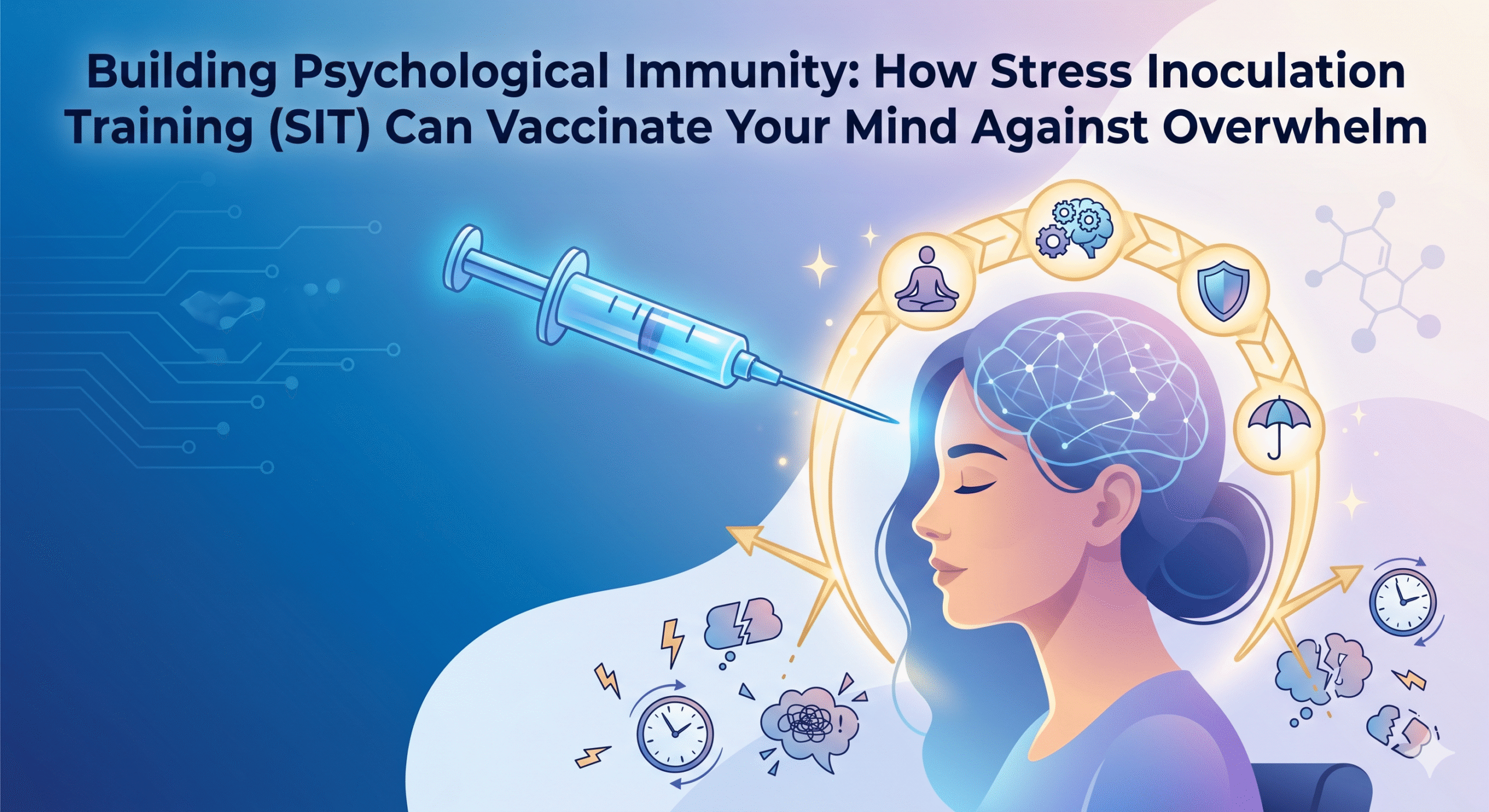
To bridge this gap, modern psychology offers a highly effective, evidence-based cognitive behavioral therapy (CBT) framework known as Stress Inoculation Training (SIT). Developed by Dr. Donald Meichenbaum in the 1970s, SIT operates on a brilliant and intuitive medical metaphor: the vaccine. Just as a physical vaccine exposes your body to a controlled, weakened strain of a virus to help your immune system build antibodies, SIT exposes individuals to controlled, manageable doses of stress. This proactive exposure builds “psychological immunity,” equipping the mind and nervous system to handle real, intense crises before they even occur.
In this post, we will explore the science behind this methodology, break down its three critical phases, and explain how you can begin building your own psychological toolkit to transform the way you interact with stress.
The Science and Efficacy Behind the Metaphor
Before diving into the mechanics of Stress Inoculation Training, it is crucial to understand the immense body of scientific evidence supporting it. This is not merely a theoretical concept; it is a battle-tested protocol utilized in some of the most high-stakes environments in the world.
SIT was formally introduced to the psychiatric community in Dr. Donald Meichenbaum’s foundational texts, most notably his book Stress Inoculation Training (originally published in 1985 and republished by Routledge in 2004). His subsequent peer-reviewed paper, co-authored with Deffenbacher in 1988, is widely celebrated for officially establishing the therapy’s structured, three-phase approach that practitioners still use today.
Since its inception, the medical and psychiatric communities have widely adopted the framework:
- The U.S. Psychological Health Center of Excellence (PHCoE): The PHCoE formally recognizes and documents SIT as a gold-standard, non-trauma-focused anxiety management program. They highlight its specific efficacy in treating complex conditions like posttraumatic stress disorder (PTSD). By teaching patients how to re-author their personal accounts of trauma and deploy effective, real-time coping strategies, SIT allows individuals to regain control over their internal narratives.
- Military and High-Stakes Environments: To prove that SIT works in the most extreme real-world conditions, we can look to a 2016 study published by Oxford University Press. Researchers examined the effects of pre-deployment SIT on U.S. Marines. The study concluded that Marines who underwent SIT prior to deployment experienced significantly fewer instances of PTSD and demonstrated a vastly improved ability to handle high-pressure, life-or-death scenarios.
- Broad Meta-Analyses: Furthermore, extensive clinical meta-analyses—including a landmark review incorporating over 1,400 participants—have definitively concluded that SIT effectively reduces symptoms of anxiety and stress. More importantly, it vastly increases a person’s daily functioning, resilience, and self-confidence.
At the core of these successes is a structured, scientifically validated progression. SIT does not throw individuals into the deep end of their anxieties. Instead, it systematically guides them through three distinct phases: Conceptualization, Skill Acquisition and Rehearsal, and Application and Follow-Through.
Phase 1: Conceptualization (Understanding Your Enemy)
The first phase of SIT is deeply collaborative and educational. You cannot fight an enemy you do not understand, and in this phase, the “enemy” is your personalized stress response.
Many people experience stress as a sudden, overwhelming wave that seemingly comes out of nowhere. The goal of the Conceptualization phase is to slow that process down and break it into identifiable parts. Therapists and individuals work together to identify specific stress triggers—whether they are impending work deadlines, social gatherings, or financial anxieties.
More importantly, this phase teaches the individual to self-monitor for the early warning signs of stress. Long before a panic attack or a mental shutdown occurs, the body and mind send signals. These might include:
- Physical symptoms: Tension in the jaw or shoulders, a slightly elevated heart rate, shallow breathing, or a localized headache.
- Cognitive patterns: The onset of catastrophic thinking (e.g., “I’m going to fail this presentation, and then I’ll lose my job”).
- Behavioral shifts: Irritability, withdrawal, or an urge to procrastinate.
By recognizing these micro-signals, individuals can intercept the stress response before it spirals out of control. Furthermore, a key component of this phase is learning to distinguish between the aspects of a stressor that can be actively changed (like how much time you dedicate to preparing for a meeting) and the aspects that must be accepted (like the overall state of the economy). This simple cognitive categorization drastically reduces feelings of helplessness.
Phase 2: Skill Acquisition and Rehearsal (Building the Toolkit)
Once the triggers and early warning signs are identified, the individual moves into the second phase: Skill Acquisition and Rehearsal. If Phase 1 is about diagnosis, Phase 2 is about writing the prescription.
In this stage, individuals build a robust, customized psychological toolkit. Because stress manifests differently for everyone, the coping mechanisms taught in this phase are tailored to the individual’s specific needs. These tools generally fall into a few primary categories:
1. Physiological Regulation (Calming the Body)
Stress triggers the sympathetic nervous system—our “fight or flight” response. Individuals learn techniques to manually override this system, such as:
- Progressive Muscle Relaxation (PMR): Systematically tensing and releasing muscle groups to release pent-up physical anxiety.
- Breathwork: Utilizing controlled breathing exercises to lower the heart rate and signal safety to the brain.
2. Cognitive Restructuring (Calming the Mind)
This involves identifying irrational or unhelpful thoughts and actively challenging them. If an individual’s default thought during a crisis is, “I can’t handle this; everything is falling apart,” they learn to logically dissect that thought. They are taught to replace it with constructive self-statements that boost self-efficacy, such as, “This is a difficult situation, but I have successfully navigated difficult situations before. I will take this one step at a time.”
3. Problem-Solving Skills
Often, stress is the result of a practical problem that feels insurmountable. SIT teaches individuals how to break massive problems into smaller, actionable steps. By focusing on micro-solutions, the overwhelming nature of the macro-problem is reduced.
4. Mindfulness and Acceptance
Individuals learn mindfulness practices to help them stay grounded in the present moment, rather than agonizing over the past or catastrophizing about the future.
During this phase, these skills are not just discussed; they are rigorously practiced in a safe environment. Just as an athlete runs drills before a championship game, individuals rehearse their coping mechanisms until they become second nature.
Phase 3: Application and Follow-Through (Bridging Theory and Reality)
The final phase of Stress Inoculation Training is where the “vaccine” is truly administered. It bridges the gap between theoretical knowledge and real-world application.
It is one thing to practice deep breathing in the quiet comfort of a therapist’s office; it is entirely another to utilize it while giving a high-stakes presentation or navigating a personal crisis. To prepare the nervous system for the real world, this phase utilizes graduated, controlled exposure.
This process is carefully tiered, gradually increasing the intensity of the stressor:
- Guided Imagery: The individual visualizes the stressful event in vivid detail while simultaneously practicing their relaxation and cognitive restructuring skills.
- Role-Playing: The individual acts out the stressful scenario (such as a difficult confrontation with a boss) with their therapist or a trusted partner, practicing their constructive self-statements and problem-solving in real-time.
- In Vivo Exposure: Finally, the individual engages in graduated real-world exposure. They intentionally place themselves in mildly stressful situations, systematically utilizing their toolkit. Over time, the intensity of these real-world situations is increased.
Because the individual has exhaustively rehearsed their responses, their nervous system is no longer caught off guard. When a real stressor hits, they do not default to panic; they default to their training. They have successfully built psychological antibodies.
A Path Forward with Tripta Wellness
The beauty of Stress Inoculation Training lies in its profound optimism. It rejects the notion that some people are simply “weak” or inherently incapable of handling pressure. Instead, it treats resilience as a mechanical skill—one that can be taught, practiced, and mastered by absolutely anyone.
At the Tripta Foundation, we believe that well-being is not the absence of stress, but the presence of effective coping strategies. We are committed to sharing resources, evidence-based practices, and guidance to help you navigate life’s inevitable challenges with grace and confidence.
If you find yourself constantly overwhelmed by the demands of life, remember that you are not lacking willpower. You simply need to build your toolkit. By understanding your triggers, actively rehearsing coping mechanisms, and gradually exposing yourself to challenges, you can rewrite your relationship with stress and reclaim your peace of mind.
To learn more about evidence-based wellness strategies, visit us at www.triptawellness.com.