
We treat willpower as an infinite resource, but behavioral psychology reveals it operates more like a battery. By the time a demanding Tuesday concludes, that battery is entirely depleted. The failure to maintain boundaries or practice self-care isn’t a lack of knowledge; it’s a failure of execution under pressure. Sustainable mental health requires moving beyond sheer discipline to architecting better default systems.

For decades, we have been sold a convenient but flawed narrative: the myth of infinite willpower. We have been conditioned to believe that maintaining healthy boundaries is merely a matter of discipline, and that falling back into unhelpful coping mechanisms is a fundamental character flaw. But behavioral psychology tells a remarkably different story. Willpower is not a moral absolute; it operates like a cognitive battery. By the time you reach the end of a relentless Tuesday filled with decision-making, crisis management, and emotional regulation, that battery is completely depleted. You cannot out-willpower an exhausted brain.
This reality requires a radical shift in how we approach our daily resilience. If we want to build sustainable mental health practices, we must stop treating behavioral change as a test of endurance and start treating it as a system design challenge. Just as we engineer robust operational frameworks to prevent organizational burnout, we must architect our personal environments to protect us from our own fatigue. True well-being doesn’t come from trying harder when our reserves are empty; it comes from designing daily systems that make the right choices the default.
Deconstructing the Habit Loop: The Brain’s Autopilot
To build systems that actually support our well-being, we must first map the underlying architecture of our behavior. The brain is remarkably efficient; it acts like a complex algorithmic system designed to minimize cognitive load. When it identifies a recurring sequence of events, it writes an automated “macro” to handle the situation with as little conscious effort as possible. This is the habit loop.
When we are operating at full capacity, we can manually override this automation. But under severe stress—when the cognitive battery is drained—our defensive logic fails, and the loop takes over completely.
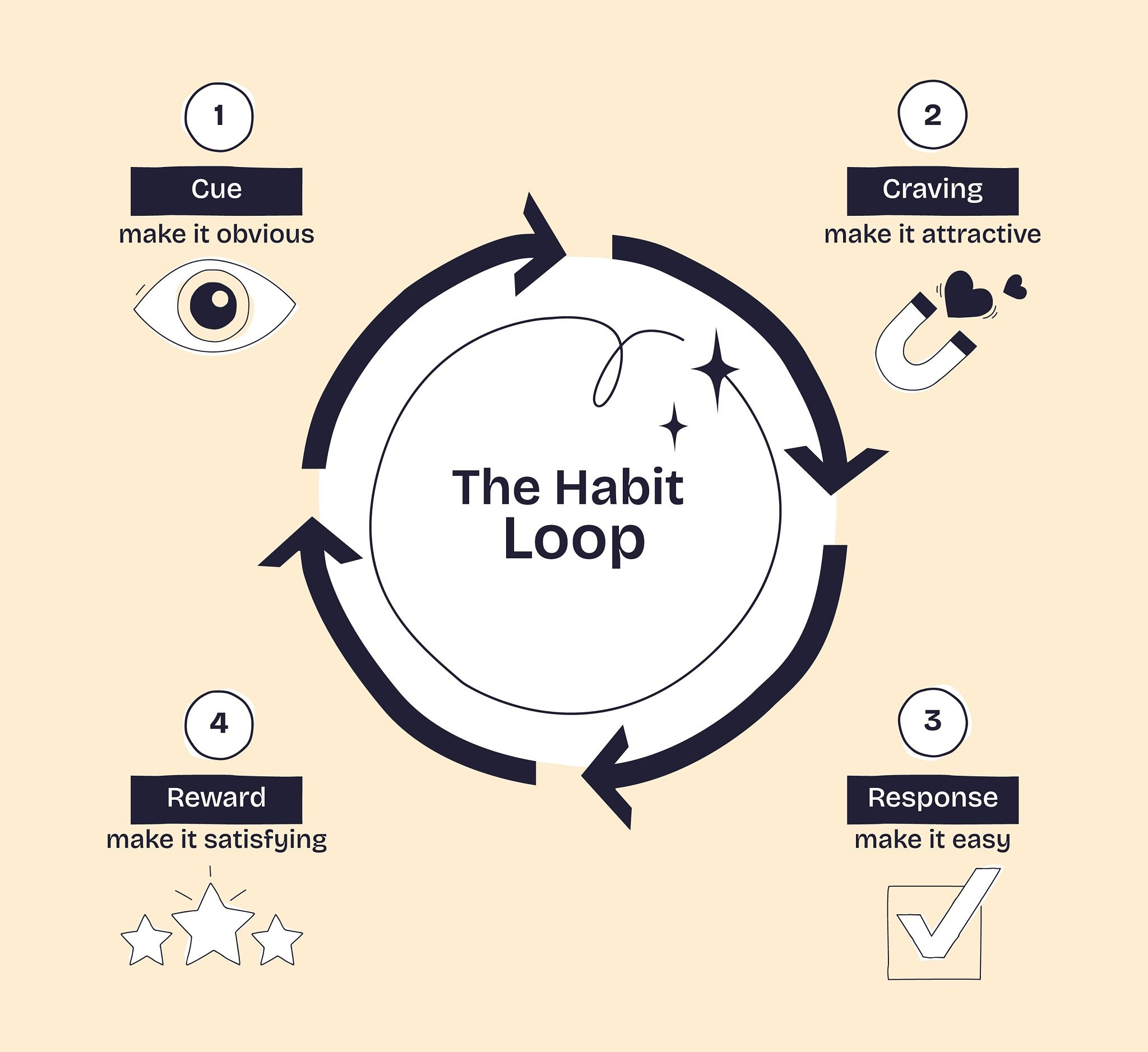
The four stages of the habit loop. Source: VectorMine / Getty Images
Understanding this mechanism requires breaking down its four distinct stages:
- The Cue (The Trigger): This is the conditional formatting that initiates the entire sequence. While we often think of cues as physical times or locations (e.g., 9:00 PM, or sitting on the couch), the most powerful cues for high-stress professionals are emotional states. The trigger is rarely “I am bored.” It is far more likely to be the subtle spike of cortisol following an intense operational meeting, or the quiet, pervasive anxiety of an unresolved administrative conflict.
- The Craving (The Motivation): Once the cue fires, the system demands a return to equilibrium. The brain registers the discomfort and immediately seeks a way to neutralize it. It is crucial to understand that you are not craving the action itself (like the taste of junk food or the content on a screen); you are craving the rapid shift in your internal state. You want relief from the cognitive load.
- The Response (The Routine): This is the path of least resistance. Under pressure, the brain ruthlessly evaluates the energy required for different actions. It bypasses high-friction, high-effort routines—like going for a run, meditating, or even talking through the frustration—because they require too much processing power. Instead, it defaults to low-friction, high-dopamine behaviors. Doomscrolling, stress-eating, and snapping at a colleague are all highly efficient responses; they require almost zero initial energy.
- The Reward (The Resolution): The loop closes when the brain receives its payout. The low-friction response successfully provides a temporary, numbing relief. The brain logs this data point immediately: This action successfully neutralized the stress. The behavior is encoded deeper into your psychological architecture, ensuring the routine runs even faster the next time the cue appears.
The danger isn’t the existence of the loop itself; it is an incredibly useful evolutionary mechanism. The problem arises when we try to insert willpower into the middle of an executing sequence. You cannot override an ingrained neurological algorithm through sheer force of will once the sequence has begun and your reserves are empty.
Instead of fighting the response, we have to engineer the environment before the cue even fires.
If we cannot consistently rely on an exhausted brain to manually override deeply ingrained stress responses, the solution isn’t to try harder. The solution is to architect the environment so that the healthy choice becomes the path of least resistance.
In systems design, if you want a user to avoid making a specific data entry error, you don’t just ask them nicely to be careful; you build defensive logic into the database—like strict validation rules—that makes the error impossible to submit. We must apply this exact same defensive architecture to our personal routines.

Intentional design reduces cognitive load. Source: Arturo Calderon / Getty Images
The Physics of Behavior: Leveraging Friction
Behavioral change ultimately comes down to managing friction. When your cognitive battery is drained, you will inevitably default to the action that requires the fewest steps. Environmental design works by intentionally manipulating that friction.
You construct your environment during high-energy periods (like a Sunday morning) to protect your decisions during low-energy slumps (like a Wednesday afternoon).
1. Increasing Friction for Negative Loops
To dismantle a destructive coping mechanism, you add operational steps between the cue and the response. The goal is to make the automated loop stall long enough for your conscious brain to catch up.
- Digital Scrolling: Instead of relying on discipline to log off, delete the app from your home screen, log out completely, and change the password to a random string of characters kept in a separate physical notebook.
- Late-Night Working: Rather than promising to close the laptop at 8:00 PM, set your home router to automatically disconnect your work devices from the Wi-Fi at a specific hour.
- Reactive Communication: Implement a mandatory rule: all emails drafted while angry or highly stressed must sit in the “Drafts” folder for a minimum of two hours before sending.
2. Decreasing Friction for Positive Loops
Conversely, if you want to install a healthy behavior, you must remove every possible barrier to entry. The action should require zero thought to initiate.
- Hydration: Don’t rely on remembering to drink water. Place a full, visual 1-liter bottle directly next to your keyboard before you sit down.
- Physical Reset: If your goal is a 10-minute walk after a tough meeting, place your walking shoes literally blocking the doorway of your office so you have to step over them to leave.
- Mindful Transitions: Leave a physical notebook open on your desk with a pen resting on it. When you finish work, the lowest-friction action is to simply write down the three things you need to do tomorrow, effectively closing the mental loops of the day.
Key insight: You are not lacking willpower; you are operating in an environment designed to distract and deplete you. Reclaiming your focus requires structural intervention, not just mental effort.
| The Goal | The Willpower Approach (High Failure Rate) | The Environmental Design Approach (High Success Rate) |
| Better Sleep | “I will try to wind down earlier tonight.” | Purchasing a physical alarm clock and charging the phone in the kitchen. |
| Healthier Eating | “I will resist the urge to order takeout when I’m tired.” | Batch-preparing three simple meals on Sunday so heating them up is faster than ordering delivery. |
| Deep Work Focus | “I will ignore my notifications for the next hour.” | Putting the phone on “Do Not Disturb” and placing it inside a desk drawer out of visual line of sight. |
Minimum Viable Habits: Designing for the Worst-Case Scenario
A critical error many professionals make when attempting to improve their mental health is designing routines that only work under optimal conditions. An hour-long morning meditation, a strict diet, and a rigorous digital detox sound fantastic on a quiet Sunday. But what happens on a Wednesday when a board meeting runs two hours late, a client is in crisis, and your inbox is overflowing?
The routine shatters. And because of the “all-or-nothing” perfectionism that plagues high performers, when the routine shatters, we abandon it entirely.
In organizational operations, a system that requires perfect conditions to function is considered a fragile, poorly designed system. We must apply this same standard to our personal well-being. This is where the concept of the Minimum Viable Habit (MVH) becomes essential.
Your MVH is the absolute baseline standard of a habit—the version you can execute even when your cognitive battery is at one percent, your stress is peaking, and your time is entirely compromised.

Structuring scalable, consistent daily routines. Source: elenabs / Getty Images
Conclusion: Systemic Compassion and the Architecture of Well-Being
When we fail to maintain a boundary, when we lose our temper, or when we spend three hours doomscrolling instead of sleeping, our default reaction is often severe self-criticism. We tell ourselves we lack discipline, focus, and drive.
But if we view our behavior through the lens of systems design, a different reality emerges. If a localized database consistently throws errors, we do not blame the data; we examine the code. We look for the structural flaw causing the friction.
We must extend this same systemic compassion to ourselves.
Missing a habit or falling back into a negative loop is rarely a character flaw; it is almost always a system error. It is a sign that your environment is demanding more cognitive load than you currently possess, and your defensive logic failed.
True resilience is not about gritting your teeth and forcing yourself to be stronger in a depleted state. It is about taking a step back and acting as the chief operating officer of your own life. It requires auditing your environment, identifying where the friction is misaligned, and redesigning the architecture so that your well-being doesn’t depend on an exhausted brain making the perfect choice.
You are not broken. You simply need a better system.
Behavioral change is rarely built on grand, sweeping lifestyle overhauls. It is built in the margins—the five minutes between meetings, the way you structure your desk, the boundaries you place around your devices. If you are struggling with chronic stress or micro-burnout, the first step is not to force yourself to work harder. The first step is an environmental audit.
Take five minutes today to identify your own Minimum Viable Habit. What is one low-friction, high-impact action you can take to protect your mental baseline this week? Whether it is mandating a 2-minute breathing exercise before opening your inbox, or moving your phone charger out of the bedroom, start small.
If you found this framework helpful, share it with a colleague who might be operating on an empty battery. Real resilience is a team effort, and it starts with having honest conversations about how we design our days.
Disclaimer
The content provided in this article is for educational and informational purposes only. It is not intended to be a substitute for professional medical advice, diagnosis, or therapeutic treatment. Always seek the advice of a qualified mental health professional, physician, or healthcare provider with any questions you may have regarding a medical or psychological condition. Never disregard professional medical advice or delay in seeking it because of something you have read here.
Please note that this content was researched, and structurally edited with the assistance of artificial intelligence tools. While every effort has been made to ensure accuracy and contextual relevance, the insights provided should not replace individualized clinical judgment or professional support.